What Is a Spiritual Awakening? Signs, Stages, Nervous System Changes & Embodiment
Sep 12, 2026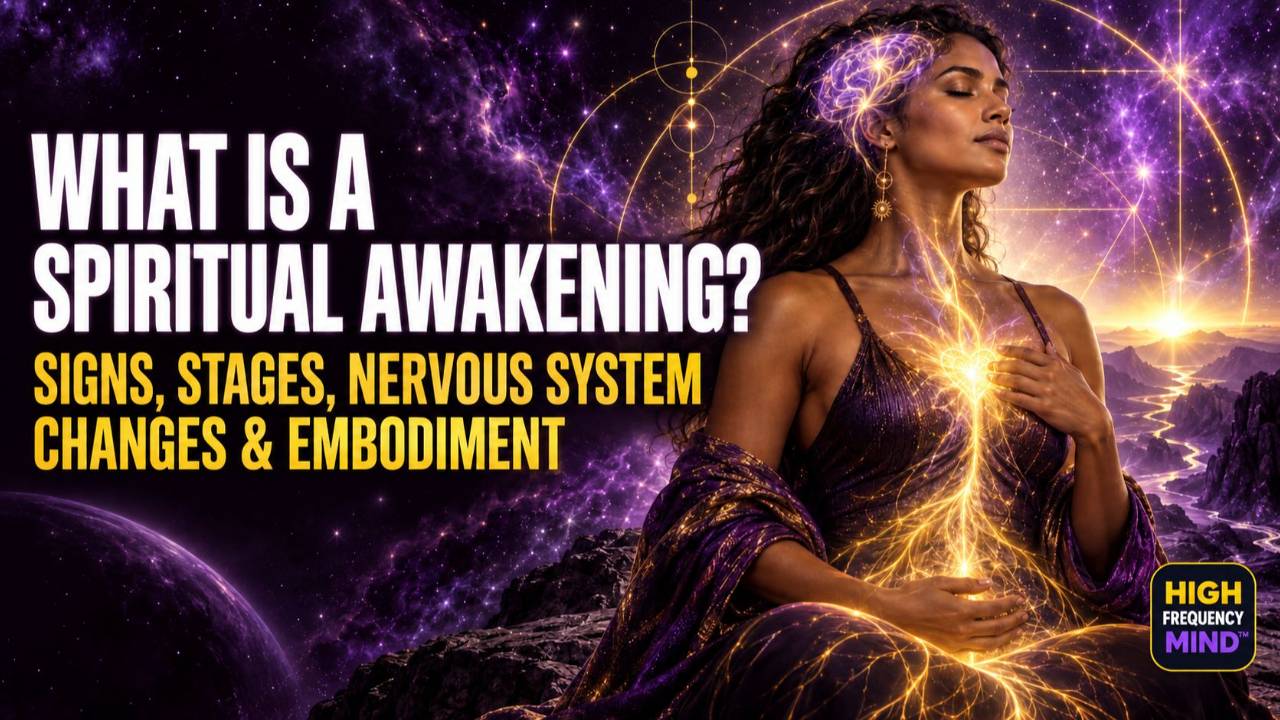
By Lindsay Goodwin, The Consciousness Medium™ & Founder of High Frequency Mind™
A spiritual awakening is a shift in awareness that changes how you understand yourself, your life, and your relationship with reality. It often begins when the identity you learned to perform no longer feels like the whole truth of who you are. Beliefs, emotional patterns, relationships, priorities, and ways of living that once felt normal may become visible in a new way.
Some awakenings arrive as a sudden experience of connection, clarity, or expanded consciousness. Others unfold slowly through loss, change, questioning, intuition, nervous-system sensitivity, or the growing recognition that your outer life no longer reflects your inner awareness.
Within High Frequency Mind™, awakening is not about escaping the human experience. It is the process of remembering the awareness beneath your conditioning and learning to live from that awareness while remaining fully present in your body, relationships, work, choices, and humanity.
THE SHORT ANSWER
Spiritual awakening moves from recognition to embodiment. You begin to see that thoughts, roles, fear, trauma, conditioning, and outside expectations are experiences moving through you—not the totality of who you are. The deeper work is allowing that realization to change the way you live.
What Does Spiritual Awakening Mean?
Spiritual awakening describes an expansion or reorientation of awareness. The way you previously understood identity, meaning, connection, consciousness, or reality begins to change. You may feel that you are perceiving life from a wider vantage point rather than only through the personality, roles, and beliefs you have accumulated.
This does not require belonging to a particular religion or spiritual tradition. Research on awakening experiences has found that they may occur during spiritual practice, but they may also emerge spontaneously through nature, psychological upheaval, creativity, or ordinary life. Participants commonly describe shifts in perception, connection, meaning, inner quiet, and values.
An awakening experience and an embodied awakening are not necessarily the same thing. A powerful moment can open perception, but embodiment develops as awareness becomes present in everyday choices. The experience may happen suddenly. Learning to live from what it revealed often unfolds over time.
What Can Trigger a Spiritual Awakening?
There is no single cause. A spiritual awakening may be catalyzed by:
- A major relationship change, loss, health experience, or life transition
- A period of emotional or psychological upheaval
- Meditation, prayer, breathwork, contemplation, or spiritual study
- A near-death experience or another encounter that changes your relationship with life
- Time in nature, creative expression, or profound beauty
- An intuitive opening or an unexpected experience of connection
- The realization that your work, relationships, or identity no longer feel aligned
- A gradual accumulation of questions that your former worldview can no longer answer
The trigger is not the awakening itself. It is often the opening through which a deeper layer of awareness becomes visible.

12 Signs of a Spiritual Awakening
Spiritual awakening does not look identical for everyone. These signs are not a diagnostic checklist, and one sign by itself does not prove that an awakening is occurring. Together, however, they may reveal that your relationship with yourself and reality is changing.
1. You Begin Questioning Who You Were Taught to Be
You notice how family, culture, relationships, fear, trauma, success, and outside expectations shaped your identity. Roles you once performed automatically begin to feel visible. You may ask, What is actually mine, and what did I learn in order to belong, survive, or be accepted?
This questioning is not evidence that your entire past was false. It is awareness beginning to distinguish your deeper knowing from your conditioning.
2. Your Old Life No Longer Fits
Work, relationships, routines, goals, or environments that once made sense may begin to feel constricting. The discomfort can be subtle at first: restlessness, emotional flatness, a desire for more solitude, or the sense that you are living a life built for an earlier version of you.
This does not always mean you need to leave everything. It means the unconscious agreements holding your life together are ready to be examined.
3. You Become More Aware of Your Thoughts
Instead of believing every thought immediately, you begin noticing thought as an event within awareness. You recognize recurring stories, predictions, judgments, and protective narratives.
This is the beginning of observer consciousness: the capacity to witness the mind without confusing every mental event for the entirety of who you are.
4. Repeating Patterns Become Harder to Ignore
Relationship dynamics, people-pleasing, over-responsibility, fear of rejection, perfectionism, emotional avoidance, or the need for certainty may become increasingly visible. What once felt like a series of unrelated events begins to reveal an underlying pattern.
Understanding why subconscious patterns keep repeating can help you see that recognition is not failure. The pattern is becoming available to awareness.
5. Your Intuition Feels Stronger—and Requires More Discernment
You may notice a clearer inner knowing, vivid dreams, synchronicities, energetic sensitivity, or a stronger sense of what feels aligned. Yet awakening also asks for discernment. Anxiety, urgency, hypervigilance, desire, and intuition can sometimes feel similar inside the body.
Learning the difference between intuition and anxiety helps inner knowing become steadier and less dependent upon fear or constant external confirmation.
6. You Feel More Sensitive to Environments and Relationships
Noise, conflict, emotional intensity, crowded environments, or relationships built around performance may feel more difficult to tolerate. Increased sensitivity can reveal what your system has been overriding, but sensitivity alone is not a measure of spiritual advancement.
The invitation is to listen without making every sensation into a spiritual message.
7. You Experience Periods of Solitude or Withdrawal
You may want fewer distractions and more space to hear yourself. Solitude can help you recognize which beliefs and desires are truly yours. A healthy inward phase creates clarity and eventually supports a more authentic return to connection.
If withdrawal becomes prolonged isolation, fear, or an inability to function, additional support may be needed. Awakening does not require you to disappear from life.
8. Your Values and Priorities Change
Status, approval, productivity, or external achievement may lose some of their authority. You may feel drawn toward truth, integrity, meaningful connection, contribution, creativity, or work that reflects who you are becoming.
The change is not always dramatic. Sometimes awakening appears as the quiet refusal to continue abandoning yourself.
9. You Feel a Greater Sense of Connection
You may experience a deeper connection with nature, other people, consciousness, the universe, God, Pure Awareness, or the intelligence moving through life. The experience may soften the sense of separation that previously organized your identity.
Connection does not erase individuality or boundaries. Embodied connection allows intimacy without losing the self.
10. Suppressed Emotions Rise to the Surface
Awakening is often associated with light, expansion, and peace, but it may also reveal grief, anger, fear, shame, or pain that was previously hidden beneath adaptation and performance.
This is one reason awakening can feel destabilizing. Greater awareness does not only illuminate what feels beautiful. It illuminates what is ready to be consciously met.
11. Certainty Gives Way to Curiosity
You become less interested in forcing every experience into one explanation. You can hold spiritual meaning and practical reality at the same time. You may trust your intuition while remaining willing to question your interpretation.
This is not a loss of faith. It is the maturation of discernment.
12. You Feel Called to Embody What You Know
Information alone is no longer enough. You want your consciousness to become visible in the way you communicate, choose, set boundaries, lead, create, care for your body, and meet uncertainty.
This is where awakening becomes self-mastery: not controlling every human response, but learning to navigate the human experience from awareness rather than conditioning.
What Are the Stages of Spiritual Awakening?
There is no universal sequence that every person follows. Awakening is cyclical, and people may revisit the same themes at deeper levels. Within the High Frequency Mind™ philosophy, the movement can be understood through four interconnected stages:
1. Understanding
You encounter an idea, experience, or realization that expands your existing worldview. You begin to understand that your conditioned identity may not be the whole of who you are.
2. Awareness
You recognize how thoughts, emotions, beliefs, nervous-system responses, and subconscious patterns are shaping perception. What was automatic becomes observable.
3. Remembrance
You reconnect with the awareness beneath your conditioning, the part of you that was never broken and whose power was never truly gone. Inner knowing becomes less about acquiring something new and more about remembering what has always been present.
4. Embodiment
You practice allowing awareness to guide your words, boundaries, relationships, work, leadership, and daily choices. The realization moves from an idea into a lived frequency.
These stages are not a ladder. Understanding may lead to awareness, embodiment may reveal another layer of conditioning, and a new life experience may begin the cycle again. This is why you can have more than one spiritual awakening.
How Can Spiritual Awakening Affect the Nervous System?
A spiritual awakening can coincide with significant changes in identity, attention, emotion, behavior, relationships, sleep, and meaning. The nervous system responds to change, even meaningful change, through the same biological systems that continuously assess safety, uncertainty, and demand.
You may notice periods of activation, restlessness, heightened sensitivity, fatigue, a need for more recovery, emotional waves, changes in sleep, or stronger awareness of bodily sensations. These experiences may feel spiritually meaningful, physiologically intense, or both.
It is important to be precise: research does not establish one universal set of “spiritual awakening nervous-system symptoms.” Studies of meditation and contemplative practice show that attention training may influence stress regulation, autonomic activity, and brain regions associated with learning, memory, self-referential processing, and emotional regulation. Research also documents that contemplative experiences can sometimes be challenging, distressing, or impairing.
The most conscious response is not to label every symptom as spiritual. It is to listen to the body, notice context, and remain open to appropriate practical or professional support.

Activation Does Not Automatically Mean Intuition
A protective nervous-system response often feels urgent. It may demand immediate certainty, repeat catastrophic possibilities, or create pressure to act so discomfort will stop. Intuition is often quieter and more consistent, although it can still communicate something important or uncomfortable.
Before assigning meaning, ask:
- What sensation is present in my body?
- What story is my mind attaching to the sensation?
- Does the message remain when the intensity softens?
- Am I receiving information, or am I seeking immediate relief from uncertainty?
- What observable facts are available in the present moment?
This pause does not silence intuition. It gives intuition space to become distinguishable from conditioned fear.
Why Rest and Regulation Matter During Awakening
Integration requires capacity. Sleep, nourishment, movement, time in nature, supportive relationships, reduced stimulation, and simple routines can help the body metabolize change. Regulation does not mean forcing yourself to feel calm at all times. It means developing enough internal safety to remain present with what is arising without automatically becoming it.
Awareness and the nervous system work together. Awareness notices the response. The body communicates its state. Repeated experiences of pausing, orienting, choosing, and returning help new responses become more available over time.
A compassionate discernment note: Intense or persistent sleeplessness, panic, confusion, inability to function, feeling unsafe, or losing contact with shared reality should not be assumed to be “just awakening.” Spiritual meaning and qualified medical or mental-health support can exist together.
What Is the Dark Night of the Soul?
The dark night of the soul is a phrase often used for a period of spiritual emptiness, disorientation, grief, or loss of meaning. Beliefs that once offered certainty may dissolve before a new understanding has fully formed.
A dark night can occur during awakening, but the terms are not interchangeable. An awakening may feel expansive, peaceful, disruptive, confusing, or quietly clarifying. A dark night specifically emphasizes the period in which the previous source of identity or meaning no longer feels available.
The void is not always a punishment or evidence that you have lost your connection. It may be the space between an identity that has ended and a more truthful way of being that has not yet taken form.
Spiritual Awakening vs. Spiritual Bypassing
Awakening increases your capacity to meet reality. Spiritual bypassing uses spiritual ideas to avoid reality.
Bypassing may look like:
- Using positivity to suppress grief, anger, or fear
- Calling every difficult relationship a karmic lesson while avoiding boundaries
- Treating physical or mental-health symptoms only as energetic messages
- Believing that being conscious means never feeling activated
- Using intuition to avoid facts, accountability, or another person’s autonomy
- Performing peace while the body remains overwhelmed
Embodiment makes room for both consciousness and humanity. You can recognize a spiritual dimension within an experience while also communicating clearly, tending to your body, seeking support, and responding to practical reality.
What Does Embodiment Mean After Spiritual Awakening?
Embodiment is awareness expressed through the human experience. It is the moment spiritual understanding becomes visible in how you live.
You may know that you are not your thoughts, but embodiment is pausing before a conditioned thought becomes a decision. You may believe in self-trust, but embodiment is honoring what you know when approval is not guaranteed. You may value compassion, but embodiment is offering compassion without abandoning your boundaries.
Embodiment can look like:
- Recognizing activation before reacting
- Allowing emotions without making them your complete identity
- Choosing boundaries that protect connection rather than punish another person
- Letting intuition inform a decision while remaining attentive to facts
- Releasing the need to perform an awakened identity
- Returning to the body instead of trying to transcend it
- Allowing your values to shape your work, leadership, relationships, and use of energy
- Repairing when your conditioning takes over

How to Integrate a Spiritual Awakening
1. Name What Is Changing
Write down the beliefs, identities, relationships, or priorities that no longer feel aligned. Clarity begins when an unnamed shift becomes visible.
2. Separate Observation from Interpretation
“My body feels activated” is an observation. “This sensation proves something bad is about to happen” is an interpretation. Creating space between the two strengthens discernment.
3. Return to the Body
Notice your feet, breath, posture, temperature, and physical environment. Ask what your body needs before deciding what the experience means.
4. Reduce the Pressure to Have an Answer
Awakening can expose the mind’s dependence upon certainty. Let some questions remain open long enough for a deeper answer to emerge.
5. Practice One Embodied Choice
Choose one small action that reflects your awareness: tell the truth kindly, keep a boundary, rest before depletion, ask for support, or pause before repeating an automatic pattern.
6. Stay Connected to Discernment
Spiritual insight does not require rejecting science, health care, supportive relationships, or practical information. Consciousness becomes more trustworthy when it can remain open to reality.
7. Let Awakening Become a Relationship
Rather than trying to complete awakening, continue meeting it. Each new layer of life may reveal another place where awareness can become embodied.
Spiritual Awakening Through the High Frequency Mind™ Framework
The Architecture of the Infinite Self™ distinguishes among the Human Avatar, the High Frequency Mind™ or Conscious Navigator, and Pure Awareness or the Infinite Self.
The Human Avatar includes the body, brain, thoughts, emotions, memory, conditioning, nervous-system responses, personality, and lived experience. Pure Awareness is the unconditioned consciousness beneath those changing experiences. The High Frequency Mind™ is the awakened relationship between them: awareness consciously navigating the human experience.
You do not awaken because you were broken. You awaken as the layers that obscured your own knowing become visible. The power beneath your conditioning was never truly gone. Embodiment is the practice of living from that remembrance.
Frequently Asked Questions
What is the simplest definition of spiritual awakening?
A spiritual awakening is a shift in awareness that changes how you understand identity, meaning, connection, and reality. It often includes recognizing that thoughts, roles, and conditioning are parts of your experience rather than the totality of who you are.
What are the first signs of spiritual awakening?
Early signs may include questioning old beliefs, feeling that your former life no longer fits, noticing thoughts and patterns more clearly, experiencing stronger intuition, changing priorities, seeking solitude, or sensing a deeper connection with life.
How long does a spiritual awakening last?
There is no universal timeline. A single awakening experience may be brief, while integration can unfold over months or years. Awakening may also occur through multiple cycles as new layers of conditioning become visible.
Can spiritual awakening cause anxiety?
Awakening may coincide with uncertainty, identity change, emotional intensity, sleep disruption, or heightened bodily awareness, all of which can feel similar to anxiety. Anxiety and spiritual meaning can coexist, so persistent or impairing symptoms deserve appropriate support rather than being dismissed as awakening.
Is spiritual awakening the same as enlightenment?
Not necessarily. Spiritual awakening usually describes a shift or opening in awareness. Enlightenment is defined differently across traditions and may refer to a more enduring realization or way of being. A powerful awakening experience does not automatically mean every conditioned pattern has been integrated.
Can you have more than one spiritual awakening?
Yes. Awakening can unfold through repeated cycles of recognition and integration. A later awakening may reveal subconscious patterns, nervous-system responses, relationships, or identities that were not visible during the first.
Does everyone experience spiritual awakening in stages?
No. Stage models can help organize an experience, but awakening is rarely linear. People may move through understanding, awareness, remembrance, and embodiment in different orders and revisit each stage many times.
What is spiritual awakening embodiment?
Embodiment means allowing awareness to shape your actual behavior: how you make decisions, communicate, set boundaries, care for your body, relate to others, lead, and respond when old patterns are activated.
How do I know whether it is intuition or nervous-system activation?
Intuition is often steady and remains recognizable after intensity settles. Nervous-system activation often feels urgent, repetitive, or focused on obtaining immediate certainty. Pausing, orienting to facts, and noticing the body can help clarify the difference.
Continue Exploring Spiritual Awakening
- Can You Have More Than One Spiritual Awakening? 9 Signs Awakening Is Becoming Embodiment
- Spiritual Awakening and the Higher Self: How to Trust Your Inner Knowing
- What Is Observer Consciousness? 5 Steps to Observe Your Mind
- How Conditioning Shapes Perception: Awareness and the Brain
- Why Subconscious Patterns Keep Repeating
- Explore The High Frequency Mind book
Scientific References
Research can describe aspects of reported awakening experiences, meditation, attention, stress regulation, neuroplasticity, and contemplative challenges. It does not define the spiritual meaning of an individual experience.
Corneille, J. S., & Luke, D. (2021). Spontaneous Spiritual Awakenings: Phenomenology, Altered States, Individual Differences, and Well-Being. Frontiers in Psychology, 12, 720579. https://doi.org/10.3389/fpsyg.2021.720579
Taylor, S., & Egeto-Szabo, K. (2017). Exploring Awakening Experiences: A Study of Awakening Experiences in Terms of Their Triggers, Characteristics, Duration and After-Effects. The Journal of Transpersonal Psychology, 49(1), 45–65. Read the study
Tang, Y.-Y., Ma, Y., Fan, Y., et al. (2009). Central and autonomic nervous system interaction is altered by short-term meditation. Proceedings of the National Academy of Sciences, 106(22), 8865–8870. https://doi.org/10.1073/pnas.0904031106
Hölzel, B. K., Carmody, J., Vangel, M., et al. (2011). Mindfulness practice leads to increases in regional brain gray matter density. Psychiatry Research: Neuroimaging, 191(1), 36–43. https://doi.org/10.1016/j.pscychresns.2010.08.006
Lindahl, J. R., Fisher, N. E., Cooper, D. J., Rosen, R. K., & Britton, W. B. (2017). The varieties of contemplative experience: A mixed-methods study of meditation-related challenges in Western Buddhists. PLOS ONE, 12(5), e0176239. https://doi.org/10.1371/journal.pone.0176239
About Lindsay Goodwin
Lindsay Goodwin, known as The Consciousness Medium™, is a consciousness teacher, intuitive medium, author, speaker, natural medicine clinician, and founder of High Frequency Mind™. Across nearly two decades of clinical and intuitive work with more than 2,000 private clients, she has explored how awareness, subconscious conditioning, nervous-system responses, and inner knowing shape the way people experience themselves, relate to others, make decisions, and practice conscious leadership.
Self-mastery is central to Lindsay’s work. She invites people to remember that we are pure awareness experiencing human life, to recognize the power within themselves, and to trust their inner knowing. A near-death experience in 2017 deepened this understanding and helped shape The Architecture of the Infinite Self, her framework for exploring who we are beneath learned roles, beliefs, and patterns. Through her books, podcast, private mentorship, and speaking, Lindsay helps people awaken to themselves and bring that awareness into the choices they make every day.
Meet Your Host & Author