How Does Conditioning Shape Perception? Awareness and the Brain
Aug 03, 2026
By Lindsay Goodwin, The Consciousness Medium™ & Founder of The High Frequency Mind™
Conditioning shapes perception by teaching the brain what to expect. Past experiences, relationships, beliefs, and nervous-system patterns influence which details you notice, how you interpret them, and what feels true before conscious thought begins. Awareness makes those filters visible so they can be examined rather than automatically repeated.
Every day, thousands of thoughts move through your mind.Some encourage you. Others might criticize, or create the illusion of feeling "stuck". Some replay conversations from years ago, while others imagine futures that have not yet happened. Most arrive automatically, often without invitation or conscious intention. Because these thoughts feel so immediate and personal, it is easy to assume they define who we are.
But what if they don't?
What if the voice in your head is not your identity, but a reflection of everything your brain has learned to predict, remember, and repeat?
This question sits at the heart of one of the most important distinctions in both modern neuroscience and the philosophy of High Frequency Mind™: the difference between awareness and conditioning.
Many people spend years trying to change their thoughts without first understanding where those thoughts come from. They attempt to become more confident, more peaceful, or more successful by replacing negative thinking with positive thinking. While this can be helpful in certain situations, it often addresses the symptom rather than the source.
Real transformation begins with something deeper. It begins with awareness.
What Is Awareness?
Awareness is one of the most frequently used words in psychology, mindfulness, neuroscience, spirituality, and personal development, yet it is rarely defined with precision.
Within the philosophy of High Frequency Mind™, awareness is not simply paying attention or becoming more mindful. It is the capacity to recognize your thoughts, emotions, sensations, and experiences without confusing them for the totality of who you are.
Awareness notices. It observes. It recognizes.
It is the aspect of experience capable of witnessing what is happening internally and externally without becoming identical to every thought that passes through the mind.
Imagine standing on the bank of a river. The water continues moving downstream. Leaves drift past. Branches occasionally float by. The current never stops. Your thoughts are much like that river. They continue flowing whether you intentionally create them or not. Awareness is the one standing on the riverbank. The river continues to move. Awareness remains.
This distinction may seem simple, but it fundamentally changes how we relate to ourselves. Instead of believing every thought that appears, awareness allows us to become curious about it.
Instead of immediately reacting to every emotion, awareness creates space to respond consciously.
Instead of assuming our current perception is absolute reality, awareness invites us to explore how that perception has been shaped.
This shift from automatic identification to conscious observation is one of the defining characteristics of psychological flexibility, emotional regulation, and personal growth.
Why Awareness Matters
Modern neuroscience increasingly suggests that much of what we experience occurs automatically.
Your brain is constantly receiving sensory information, comparing it to previous experiences, and generating predictions about what it expects to happen next. These processes occur long before conscious awareness enters the picture.
This framework, often described as predictive processing, helps explain why two people can experience the same event yet interpret it in completely different ways.
Each person's brain is drawing from a different history of memories, beliefs, emotions, relationships, and learned experiences.
In other words, much of what we call reality is filtered through the lens of conditioning. Without awareness, these predictions operate automatically. With awareness, we begin noticing them.
This does not stop the brain from making predictions. Instead, it changes our relationship to those predictions. We begin asking questions we may have never considered before.
Is this thought objectively true? Is this reaction based on what is happening now, or on something my brain has learned from the past?
Am I responding consciously, or am I repeating a familiar pattern? These questions create the possibility of choice.
Awareness Is Not the Same as Thinking
One of the greatest misconceptions in mindfulness and personal development is the belief that becoming more aware simply means thinking more about ourselves.
In reality, excessive thinking often creates the opposite effect. Overthinking keeps us inside the stories generated by the mind. Awareness allows us to observe those stories without immediately becoming immersed in them. Imagine watching clouds move across the sky. Some are dark. Some are bright. Some pass quickly. Others linger.
The sky does not become the clouds. It simply allows them to appear and disappear. In much the same way, awareness provides the space within which thoughts arise and pass.
This perspective is supported by research in cognitive psychology and neuroscience, which increasingly recognizes the value of metacognition, our ability to think about our own thinking. Developing metacognitive awareness has been associated with greater emotional regulation, improved decision-making, reduced cognitive rigidity, and increased psychological well-being.
Within High Frequency Mind™, awareness extends beyond observing thoughts. It also includes recognizing emotional patterns, bodily sensations, intuitive knowing, conditioned beliefs, and the countless unconscious processes that influence how we experience the world.
Rather than asking, "How do I stop thinking?" the more useful question becomes:
"Who is aware that these thoughts are happening?"

Conditioning: The Hidden Architecture of Perception
If awareness is our capacity to observe experience, conditioning is the collection of learned patterns through which the brain interprets experience.
From the moment we are born, the brain begins learning. It learns through relationships. It learns through repetition. It learns through emotion. It learns through success, disappointment, praise, fear, and belonging.
Over time, these experiences form predictive models that help us navigate the world efficiently. The brain uses them to anticipate what is likely to happen next, reducing uncertainty and conserving energy.
This process is remarkably intelligent. It is also incomplete. Because the brain predicts the future using the past, it naturally favors familiarity over novelty.
This explains why old emotional patterns can persist even when our external circumstances have changed.
- Someone who learned early in life that love must be earned may continue overextending themselves in relationships.
- Someone who experienced repeated criticism may automatically anticipate rejection, even when no evidence supports that expectation.
- Someone who grew up in unpredictability may unconsciously feel uncomfortable when life becomes calm because calmness itself feels unfamiliar.
These reactions are not personal failures. They are learned predictions. Recognizing that distinction is one of the first steps toward living more consciously.
The Neuroscience of Conditioning
Conditioning begins long before we have the language to describe it. The brain is constantly learning from repetition, emotion, relationships, and experience. Over time, these experiences become part of the internal models the brain uses to predict what is likely to happen next.
This process is closely connected to predictive processing. Rather than waiting for the world to explain itself, the brain compares new information to what it already knows. It uses memory, expectation, and previous experience to create an interpretation of the present moment.
That interpretation can feel objective, even when it is deeply influenced by the past.
A person who has repeatedly experienced rejection may become highly sensitive to subtle changes in tone, facial expression, or communication. Their brain may predict rejection before it has actually occurred. Someone who grew up in an unpredictable environment may remain alert even when life becomes stable. The body and brain continue preparing for what they have learned to expect.
These patterns are not evidence that someone is broken. They are signs that the nervous system and brain have adapted to experience.
The challenge is that adaptations can continue operating long after they are needed. When this happens, the brain may filter the present through expectations formed in the past.
Awareness makes those expectations visible. Without awareness, a prediction feels like truth. With awareness, it becomes something we can observe, question, and update.
This is where the relationship between conditioning and perception becomes so important. We do not simply respond to what happens. We respond to what our brain believes is happening, based on everything it has learned before.
For a practical way to recognize these filters in real time, read What Is Observer Consciousness?. To understand why familiar responses can continue even after you recognize them, explore Why Do Subconscious Patterns Keep Repeating?.
Awareness, Consciousness, and Self-Awareness
The words awareness, consciousness, and self-awareness are often used interchangeably, but they describe different aspects of experience.
Consciousness is the broad condition of having experience. It includes thoughts, sensations, emotions, perception, memory, and the sense that something is happening.
Awareness is the capacity to recognize what is happening within that experience.
Self-awareness is the ability to direct that awareness toward ourselves. It allows us to notice our thoughts, emotions, behaviors, values, and patterns. It also helps us understand how we affect others and how our internal world influences the choices we make.
Within the philosophy of High Frequency Mind™, awareness is more than intellectual understanding. It is the capacity to recognize the difference between what is being experienced and the conditioned interpretation of that experience.
You may feel fear without assuming the fear is giving you an objective description of reality. You may notice a critical thought without accepting it as a permanent truth about yourself. You may recognize an emotional reaction while also understanding that it has been shaped by memory, expectation, and nervous system learning. This does not make the experience less real. It creates a fuller relationship with it.
Awareness allows us to hold both truths at once. The emotion is real, and the interpretation may still be conditioned. That distinction creates room for conscious response.
Neuroplasticity and the Possibility of Change
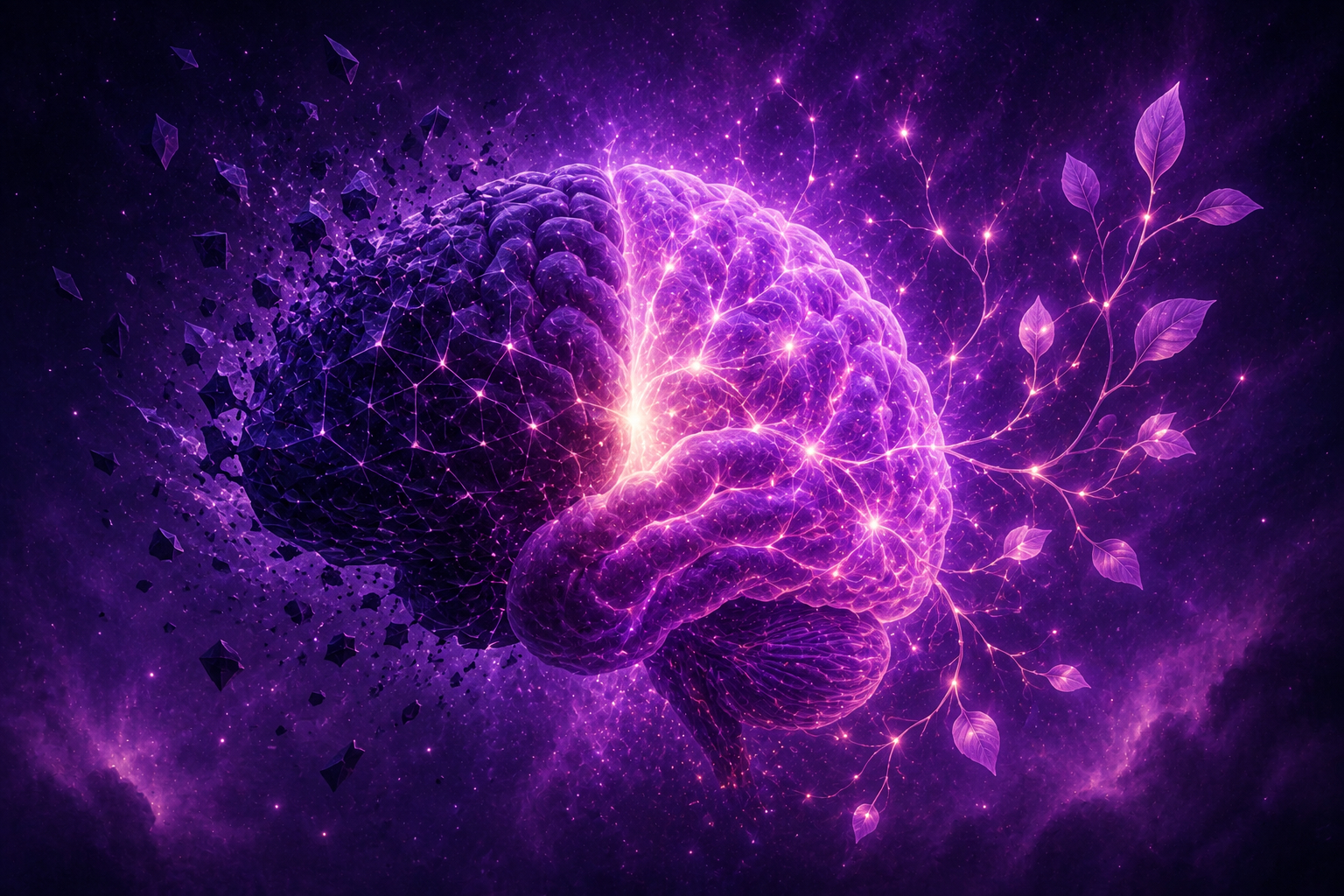
The brain is shaped by experience, but it is not permanently fixed by it. Neuroplasticity refers to the brain’s ability to reorganize itself by forming, strengthening, weakening, and refining neural connections. This process continues throughout life and provides the biological foundation for learning, adaptation, memory, and behavioral change.
Neuroplasticity does not mean that every pattern can be changed instantly. Neural pathways become stronger through repetition, and deeply established responses often require time, consistency, and new experiences before they begin to shift.
Awareness is important because it allows us to recognize the moment when an old pattern becomes active.
Without awareness, the reaction unfolds automatically. With awareness, a pause becomes possible. Within that pause, we can choose a different response. Each new response gives the brain new information.
When those responses are repeated, the brain begins to update its predictions. A person who once expected rejection may gradually learn that connection can also be safe. Someone who associated rest with danger or guilt may slowly build a new relationship with stillness. A person who learned to silence themselves may begin discovering that honest expression does not always lead to abandonment. This is why lasting change usually requires more than insight alone.
Understanding a pattern is valuable, but the brain also needs repeated experiences that contradict the old prediction. New neural pathways become stronger through practice, emotional relevance, and consistency.
Awareness opens the door, but experience helps the brain walk through it.
Why Awareness Is More Powerful Than Positive Thinking
Positive thinking can influence mood, motivation, and attention, but it is not the same as awareness.
When positive thinking is used to override fear, grief, anger, or uncertainty, it can create another layer of internal conflict. The mind may repeat that everything is fine while the nervous system continues signaling danger.
Awareness does not require us to deny what we feel. It allows us to recognize what is happening without becoming completely controlled by it.
For example, positive thinking might say, “I should not feel afraid because everything will work out.”
Awareness might say, “Fear is present, and I can become curious about what it is trying to protect.”
The second response creates a more honest relationship with the human experience. It does not treat difficult emotions as failures. It recognizes them as information.
Within High Frequency Mind™, awareness is not a strategy for escaping discomfort. It is the capacity to remain present enough to understand what the experience is revealing.
This is why awareness creates deeper change than simply replacing one thought with another. It allows us to see the conditioning beneath the thought, the nervous system response beneath the reaction, and the belief beneath the behavior.
Positive thinking may change the content of the mind. Awareness changes our relationship with the mind itself.
The Relationship Between Awareness and the Human Experience
High Frequency Mind™ is a contemporary philosophy of consciousness exploring the relationship between awareness and the human experience.
It integrates insights from neuroscience, nervous system regulation, the subconscious mind, intuition, spirituality, and consciousness to examine how conditioning shapes perception and how awareness changes the way we experience ourselves and the world.
Within this philosophy, Pure Awareness is understood as the Infinite Creator, the unconditioned source of all consciousness and the constant within an ever-changing creation. The Infinite Self, also called the Higher Self, is the individualized expression of that Pure Awareness. The Human Experience is the embodied expression through which consciousness experiences itself in physical form.
The High Frequency Mind™ is the awakened relationship between awareness and the Human Experience.
This does not mean leaving the human condition behind. It means recognizing that thoughts, emotions, biology, memory, conditioning, and nervous system responses are part of the human experience, but they are not the entirety of who we are.
The goal is not to transcend humanity. The goal is to understand consciousness through it.
When awareness becomes more present within the human experience, conditioned perception begins to loosen. We may still feel fear, anger, grief, desire, uncertainty, and vulnerability, but we are less likely to assume that every emotional state defines the whole truth.
Awareness allows us to participate in life without becoming completely lost in the stories our conditioning creates.
How to Cultivate Awareness in Everyday Life
Awareness is not something we force into existence. It is something we practice recognizing.
One of the simplest ways to begin is by noticing the language of automatic thought. Statements such as “I always do this,” “Nothing ever works for me,” or “This is just who I am” often reveal places where conditioning has become fused with identity.
Instead of immediately trying to replace the thought, pause and examine it.
Ask yourself where the belief came from, what experience may have reinforced it, and whether it accurately reflects the present moment.
You can also bring awareness to the body. Before reacting, notice where the response appears physically. Tightness in the chest, tension in the jaw, shallow breathing, or a sudden urge to withdraw may signal that the nervous system is responding before the conscious mind has interpreted what is happening.
This does not mean that every bodily response is wrong. It means the response deserves attention before it becomes action.
Another useful practice is to separate observation from interpretation.
For example, “They have not responded to my message” is an observation.
“They are ignoring me because I am not important” is an interpretation.
The interpretation may feel immediate and convincing, but awareness helps us recognize that the brain has filled in missing information using past experience. This distinction creates space for curiosity.
Over time, these small moments of awareness change the way we relate to perception. We become more capable of noticing when the past is shaping the present and more willing to question what once felt unquestionable.
Frequently Asked Questions
What is awareness?
Awareness is the capacity to recognize your thoughts, emotions, sensations, and experiences without confusing them for the totality of who you are. Rather than becoming identified with every thought or emotional reaction, awareness allows you to observe them with curiosity and intention. Within the philosophy of High Frequency Mind™, awareness is understood as the foundation for living the human experience consciously rather than automatically.
What is the difference between awareness and consciousness?
Consciousness refers to the broad condition of having subjective experience, including thoughts, emotions, sensations, and perception. Awareness is the capacity to recognize what is occurring within that experience. While consciousness provides the experience itself, awareness allows us to observe that experience without becoming completely identified with it.
What is self-awareness?
Self-awareness is the ability to direct awareness toward your own thoughts, emotions, behaviors, beliefs, and patterns. It allows you to recognize how your internal experiences influence your decisions, relationships, and perception of the world.
What is conditioning?
Conditioning is the collection of learned patterns, beliefs, emotional responses, and behaviors acquired through life experiences, relationships, culture, and repeated exposure. These patterns influence how the brain predicts, filters, and interprets reality, often operating outside of conscious awareness.
How does conditioning affect perception?
The brain continuously predicts and interprets incoming information using previous experiences, memories, and learned expectations. As a result, perception is influenced not only by what is happening in the present moment but also by conditioning developed throughout life. Awareness allows us to recognize when those learned predictions are shaping our interpretation of reality.
What is predictive processing?
Predictive processing is a leading neuroscience theory suggesting that the brain actively predicts incoming sensory information rather than passively observing reality. It continuously compares its predictions with actual sensory input, updating those predictions when they no longer match experience.
What is neuroplasticity?
Neuroplasticity is the brain's ability to reorganize and strengthen neural pathways throughout life. Learning, experience, repeated behavior, and intentional practice all contribute to changes in neural connections, allowing the brain to continually adapt and evolve.
Can awareness change the brain?
Awareness alone does not immediately change neural pathways, but it creates the opportunity for different choices and experiences. When new responses are practiced consistently, neuroplasticity allows the brain to develop new patterns over time.
What is High Frequency Mind™?
High Frequency Mind™ is a contemporary philosophy of consciousness exploring the relationship between awareness and the human experience. It integrates insights from modern neuroscience, nervous system regulation, the subconscious mind, intuition, spirituality, and consciousness to better understand how conditioning shapes perception and how awareness transforms the way we experience life.
Continue Exploring
- Episode 15: Who Are You Beneath the Conditioning?
- Learn more about Lindsay Goodwin, The Consciousness Medium™
- Download the Infinite Self-Mastery eBook guide (my gift to you)
- Join the waitlist & get your first chapter of The High Frequency Mind Book
- Listen to more podcast episode on High Frequency Mind Podcast
Scientific References
High Frequency Mind™ integrates contemporary neuroscience with the philosophy of consciousness. The following peer-reviewed publications provide scientific context for several of the concepts discussed throughout this article, including awareness, predictive processing, conditioning, neuroplasticity, and metacognition.
Burke, S. N., & Barnes, C. A. (2006). Neural plasticity in the ageing brain. Nature Reviews Neuroscience, 7(1), 30–40. https://doi.org/10.1038/nrn1809
Clark, A. (2013). Whatever next? Predictive brains, situated agents, and the future of cognitive science. Behavioral and Brain Sciences, 36(3), 181–204. https://doi.org/10.1017/S0140525X12000477
Keller, G. B., & Mrsic-Flogel, T. D. (2018). Predictive processing: A canonical cortical computation. Neuron, 100(2), 424–435. https://doi.org/10.1016/j.neuron.2018.10.003
den Ouden, H. E. M., Kok, P., & de Lange, F. P. (2012). How prediction errors shape perception, attention, and motivation. Frontiers in Psychology, 3, Article 548. https://doi.org/10.3389/fpsyg.2012.00548
Flavell, J. H. (1979). Metacognition and Cognitive Monitoring: A New Area of Cognitive–Developmental Inquiry. American Psychologist, 34(10), 906–911. https://doi.org/10.1037/0003-066X.34.10.906
About Lindsay Goodwin
Lindsay Goodwin, known as The Consciousness Medium™, is a consciousness teacher, intuitive medium, author, speaker, natural medicine clinician, and founder of High Frequency Mind™. Across nearly two decades of clinical and intuitive work with more than 2,000 private clients, she has explored how awareness, subconscious conditioning, nervous-system responses, and inner knowing shape the way people experience themselves, relate to others, make decisions, and practice conscious leadership.
Self-mastery is central to Lindsay’s work. She invites people to remember that we are pure awareness experiencing human life, to recognize the power within themselves, and to trust their inner knowing. A near-death experience in 2017 deepened this understanding and helped shape The Architecture of the Infinite Self, her framework for exploring who we are beneath learned roles, beliefs, and patterns. Through her books, podcast, private mentorship, and speaking, Lindsay helps people awaken to themselves and bring that awareness into the choices they make every day.
Meet Your Host & Author