What Is Observer Consciousness? 5 Steps to Observe Your Mind
Sep 02, 2026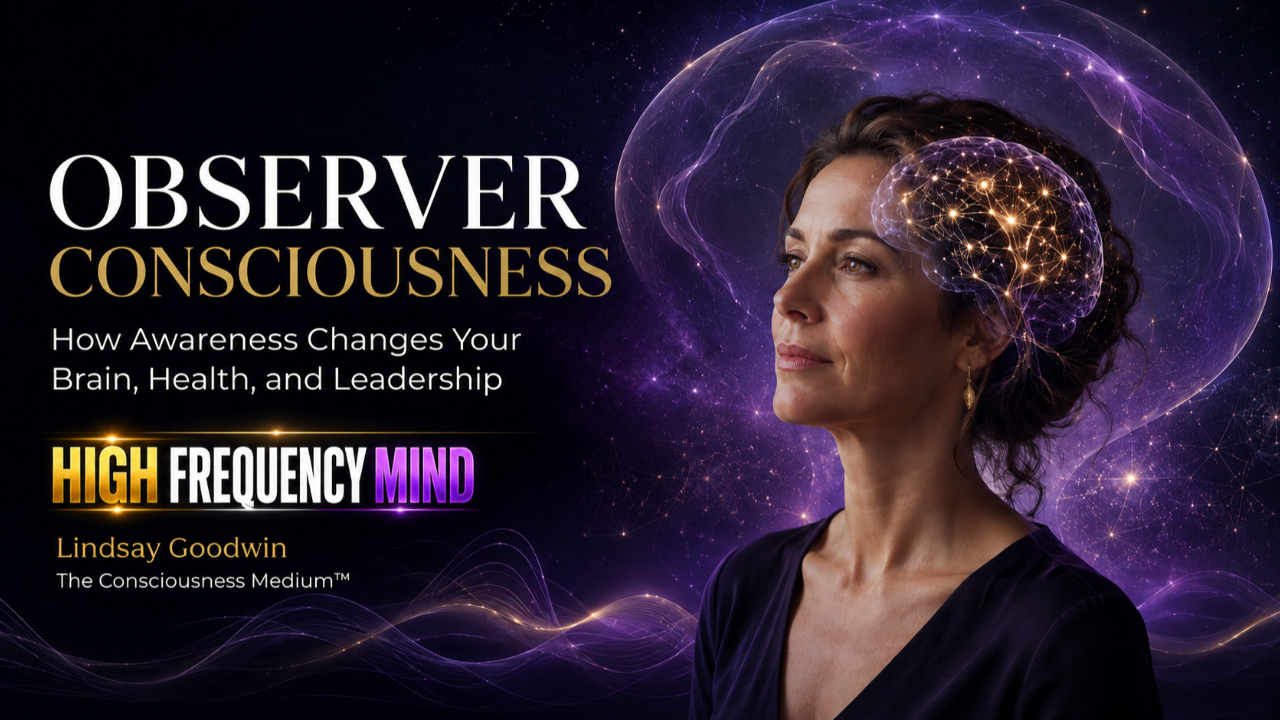
By Lindsay Goodwin, The Consciousness Medium™ & Founder of High Frequency Mind™
Observer consciousness is the ability to notice your thoughts, emotions, physical sensations, and nervous-system reactions without automatically identifying with or acting on them. Becoming the conscious observer creates space between what arises within you and the choice you make next.
There is a moment, often no longer than a breath, when you realize that a thought is happening inside you but the thought is not the whole of you. You notice the fear before it becomes a decision. You recognize the old story before it becomes another repeated pattern. You feel the impulse to defend, prove, withdraw, or control, yet something deeper remains present enough to choose.
That moment is the beginning of observer consciousness.
Observer consciousness is the capacity to witness your thoughts, emotions, physical sensations, and conditioned reactions without automatically becoming them. In psychology and neuroscience, related capacities are often discussed as meta awareness, metacognition, decentering, interoception, and self regulation. In spiritual traditions, the same territory may be described as the witness, pure awareness, or the higher self.
These languages are not identical, and they should not be forced into false agreement. Yet they point toward a meaningful human ability: we can become aware of our internal experience while it is happening. When we do, we create space between conditioning and choice.
What Is Observer Consciousness?
Observer consciousness is not cold detachment from your life. It is intimate presence with your life. It allows you to notice what is happening within you while remaining connected to your body, values, relationships, and environment.
Imagine receiving a message from a client, colleague, partner, or family member that feels critical. Your body tightens. Your mind starts building a case. A familiar thought appears: I am not respected. Without awareness, that thought can become your reality in seconds. You may send a reactive reply, shut down, overexplain, or spend the rest of the day replaying the exchange.
Observer consciousness does not prevent the first reaction. It helps you see the reaction as an event within consciousness rather than an unquestionable command. You can notice the tightness, name the fear, examine the story, and decide what the moment actually requires.
This is why observer consciousness matters far beyond meditation. It affects how you care for your health, how you lead, how you make decisions, and how much of your life is directed by inherited patterns rather than conscious intention.
The Neuroscience of Watching Your Own Mind
Science does not currently offer one complete explanation of consciousness. It does, however, study several capacities involved in observing our own mental activity.
Metacognition is commonly described as thinking about, monitoring, or evaluating our own thinking. It is involved in learning, memory, planning, confidence, and decision making. Meta awareness is the recognition that a thought, feeling, or attentional state is occurring now. Decentering is the ability to experience thoughts and emotions as temporary mental events rather than literal facts or fixed definitions of the self.
Research on mindfulness provides one practical window into these processes. Reviews of neuroscience research describe attention control, emotion regulation, and altered self awareness as interacting parts of mindful self regulation. Brain systems commonly discussed in this research include areas involved in attention, body awareness, self referential processing, and emotional response. The evidence is promising, but it is also evolving, and responsible interpretation matters. A brain scan does not prove a spiritual worldview, and a spiritual experience should not be reduced to a single brain region.
The more useful conclusion is grounded: awareness can change how we relate to internal signals. It can help us notice when the mind is remembering, predicting, protecting, or rehearsing instead of simply perceiving what is present.
If you want to explore how prediction and conditioning shape perception, read The Neuroscience of Manifestation: How Your Brain Predicts and Shapes Reality.
Observer Consciousness Is Not Dissociation
This distinction is essential. Healthy observation increases contact with reality. Dissociation can involve disconnection from thoughts, feelings, memory, identity, or the body. Observer consciousness invites you into fuller presence. It does not ask you to float above pain, deny emotion, or pretend that difficult experiences are spiritually insignificant.
You are not practicing observer consciousness when you use spiritual language to avoid grief, anger, accountability, medical care, or necessary boundaries. You are practicing it when you can remain present with an experience without allowing the first automatic interpretation to control your next action.
True witnessing includes the body. It recognizes that a racing heart, collapsed posture, shallow breath, or clenched jaw may carry meaningful information. It also recognizes that a body signal is not always a prophecy. Sensation can be honored without being made into certainty.
How Awareness Supports Nervous System Health
Your nervous system is constantly evaluating safety, demand, uncertainty, and available resources. Many reactions begin before conscious language catches up. This is not a personal failure. It is part of being human.
Observer consciousness gives you a way to meet those reactions with curiosity. Instead of asking, “What is wrong with me?” you can ask, “What is my system responding to right now?” That shift changes the relationship between sensation and identity.
A mindful approach to emotion regulation may involve attention, acceptance, body awareness, and a change in how an experience is appraised. Research reviews suggest that mindfulness based approaches can support emotional regulation, while also emphasizing that definitions, methods, and results vary across studies. Awareness is a skill, not a magical guarantee, and it is not a replacement for appropriate mental or physical health care.
In everyday life, the health value may appear in small but consequential choices. You recognize exhaustion before agreeing to another obligation. You notice that urgency is driving your eating, sleeping, or working patterns. You feel resentment early enough to communicate a boundary. You discover that your body has been carrying a belief your conscious mind says it no longer holds.
These moments help you move from automatic survival strategies toward a more responsive relationship with your own system.

Observer Consciousness in Business
Business amplifies conditioning. Visibility can activate fear of judgment. Growth can activate fear of responsibility. Receiving money can activate beliefs about worth, safety, and belonging. Leadership can activate the need to control outcomes or be seen as certain.
Without observer consciousness, a founder may mistake activation for strategy. They may change an offer because one person objected, avoid a necessary conversation because conflict feels unsafe, or keep producing more because stillness brings them face to face with doubt.
The observing mind makes a different kind of leadership possible. It allows you to ask:
- Is this decision coming from evidence, intuition, fear, or the need for approval?
- What is happening in my body as I consider this choice?
- Am I responding to the current situation or to an older experience that feels similar?
- What would remain true if urgency were removed?
- Which response is aligned with both my values and the available facts?
This does not make leadership passive. It makes leadership less governed by unconscious reflex. You can act quickly when needed, but speed is no longer confused with reactivity.
Why Conscious Leadership Begins With Self Observation
Conscious leadership is not a polished identity. It is the practice of noticing how your internal state enters the room with you.
A leader who cannot observe their fear may spread urgency across an entire team. A leader who cannot recognize their need for validation may reward agreement and punish honest feedback. A leader who cannot witness shame may defend a mistake instead of repairing it.
By contrast, a leader with growing observer consciousness can notice activation without making everyone else responsible for regulating it. They can distinguish confidence from performance, intuition from avoidance, and authority from control. They can receive information that challenges their self image without immediately rejecting the messenger.
This is not perfection. Conscious leaders still become reactive. The difference is that they develop the capacity to recognize, take responsibility, repair, and choose again.

The Spiritual Meaning of the Observer
From the perspective I teach through High Frequency Mind™, the observer is more than a cognitive skill. It is an opening into the part of you that can witness conditioning without being defined by it.
Your personality, memories, roles, beliefs, and nervous system patterns are real parts of your human experience. They shape what you notice and how you respond. Yet the awareness that can see those patterns is not identical to any one of them.
This is one way to understand the higher self without abandoning the human self. The higher self is not used to escape the body. It brings a wider intelligence into relationship with the body. It does not erase conditioning through positive thought. It makes conditioning visible enough that a new relationship with it becomes possible.
If this distinction feels familiar, continue with Are You Your Thoughts? and What Is Awareness? Awareness vs. Conditioning.
A Five Step Observer Practice
You do not need to silence your thoughts to practice observer consciousness. You need a repeatable way to meet them.
- Pause. Interrupt the automatic sequence for one full breath. If the situation allows, give yourself more time before responding.
- Name what is present. Use simple language: fear is here, pressure is here, defensiveness is here, or excitement is here. Naming creates clarity without turning the experience into an identity.
- Locate it in the body. Notice temperature, pressure, movement, posture, breath, and tension. Stay curious rather than trying to force the sensation away.
- Separate fact from story. Ask what you directly know, what you are assuming, and what memory or expectation may be shaping the interpretation.
- Choose the next aligned action. The next action may be speaking, waiting, asking a question, setting a boundary, seeking support, or changing course.
The goal is not to become emotionally neutral. The goal is to become conscious enough that emotion can inform you without automatically commanding you.
Observer Consciousness, Intuition, and Anxiety
Observer consciousness is also the ground of discernment. When you can witness internal signals without immediately reacting, you become better able to distinguish a clear inner knowing from an anxious prediction.
Intuition often arrives with a simple quality, even when its message is uncomfortable. Anxiety tends to multiply possibilities, seek certainty, and repeat its case. Neither can be identified by one sensation alone. Context, patterns, evidence, and nervous system state all matter.
For a deeper exploration, read Intuition vs. Anxiety: How to Tell the Difference and Trust Your Inner Knowing.
Signs Your Observer Consciousness Is Strengthening
- You notice a thought before treating it as truth.
- You recover from emotional activation with more honesty and less shame.
- You can receive feedback without immediately collapsing or attacking.
- You recognize recurring patterns while they are unfolding, not only afterward.
- You can stay connected to your body during difficult conversations.
- You make fewer decisions solely to end discomfort.
- You become more willing to change your mind when new evidence appears.
- Your spirituality leads to greater responsibility, compassion, and grounded action.
Progress is not measured by never being triggered. It is measured by the growing space between stimulus, interpretation, and response.
When Awareness Reveals a Repeating Pattern
Seeing a pattern can be liberating, but awareness alone does not always complete the work. Some patterns are reinforced by repetition, relationships, environment, identity, and deeply learned protective responses. They may require new behavior, sustained practice, professional care, or a change in circumstances.
The observer helps you begin from truth. It allows you to say, “This pattern is present, but it is not the totality of who I am.” From there, responsibility becomes possible without self condemnation.
Explore this more deeply in Why Do Subconscious Patterns Keep Repeating?.

Frequently Asked Questions
Is observer consciousness the same as mindfulness?
They overlap, but they are not always used in exactly the same way. Mindfulness generally involves intentional, present centered awareness with an accepting or nonjudgmental quality. Observer consciousness emphasizes the capacity to witness thoughts, emotions, sensations, and identity patterns without automatically becoming them.
Is the observer the higher self?
In spiritual language, the observer may be experienced as an expression of the higher self or pure awareness. In scientific language, related abilities may be discussed through meta awareness, metacognition, and decentering. Science does not establish that these terms describe the same metaphysical reality, so it is helpful to respect both the overlap and the distinction.
Can observer consciousness improve decision making?
It can support better decision processes by helping you monitor confidence, assumptions, emotion, and automatic reactions. It does not make a person infallible. Good decisions still require evidence, context, expertise, values, and a willingness to revise your view.
How does observer consciousness affect health?
Practices that cultivate mindful awareness have been studied in relation to attention, stress, emotional regulation, and mental health. Results vary, and observer practices are not a substitute for medical or mental health treatment. Their practical value often lies in recognizing internal patterns earlier and responding with greater choice.
How can leaders practice observer consciousness at work?
Begin by pausing before consequential responses, naming your internal state, separating facts from assumptions, and considering how your activation may affect other people. Conscious leadership also requires accountability, transparent communication, and repair when your reactions create harm.
Awareness Is Where Choice Begins
You do not become free by rejecting the human parts of you. You become freer by seeing them clearly enough to stop confusing every thought, fear, role, and pattern with your deepest identity.
Observer consciousness is the threshold between reaction and response. In health, it helps you listen without immediately catastrophizing. In business, it helps you separate strategy from survival. In leadership, it helps you carry authority without projecting your unexamined patterns onto others. In spiritual life, it opens the possibility that you are both the human experience and the awareness capable of meeting it.
That awareness does not remove you from your life. It returns you to your life with more presence, responsibility, and choice.
Go Deeper With High Frequency Mind™
If you are ready to understand the patterns shaping your consciousness and strengthen your connection with your inner knowing, explore Lindsay’s work through private sessions and ways to work with Lindsay.
You can also explore The High Frequency Mind™ book for a deeper framework connecting awareness, conditioning, and the infinite self.
About Lindsay Goodwin
Lindsay Goodwin, known as The Consciousness Medium™, is a consciousness teacher, intuitive medium, author, speaker, natural medicine clinician, and founder of High Frequency Mind™. Across nearly two decades of clinical and intuitive work with more than 2,000 private clients, she has explored how awareness, subconscious conditioning, nervous-system responses, and inner knowing shape the way people experience themselves, relate to others, make decisions, and practice conscious leadership.
Self-mastery is central to Lindsay’s work. She invites people to remember that we are pure awareness experiencing human life, to recognize the power within themselves, and to trust their inner knowing. A near-death experience in 2017 deepened this understanding and helped shape The Architecture of the Infinite Self, her framework for exploring who we are beneath learned roles, beliefs, and patterns. Through her books, podcast, private mentorship, and speaking, Lindsay helps people awaken to themselves and bring that awareness into the choices they make every day.
Research References
Meet Your Host & Author