The Neuroscience of Manifestation: How Your Brain Predicts and Shapes Reality
Aug 03, 2026
By Lindsay Goodwin, The Consciousness Medium™ & Founder of The High Frequency Mind™
What if manifestation isn't about attracting a new reality, but understanding the one your brain is already creating?
Manifestation has become one of the most influential ideas in modern personal development. Millions of people have embraced the belief that changing their thoughts can change their lives. Books, podcasts, courses, and social media are filled with advice encouraging positive thinking, visualization, affirmations, and energetic alignment. These practices have helped many people become more intentional, hopeful, and optimistic about their future.
Yet despite their popularity, they often leave people asking the same question.
"Why am I doing everything I've been taught and still feeling stuck?"
Perhaps the problem is not that manifestation doesn't work. Perhaps the problem is that we have misunderstood what is actually changing.
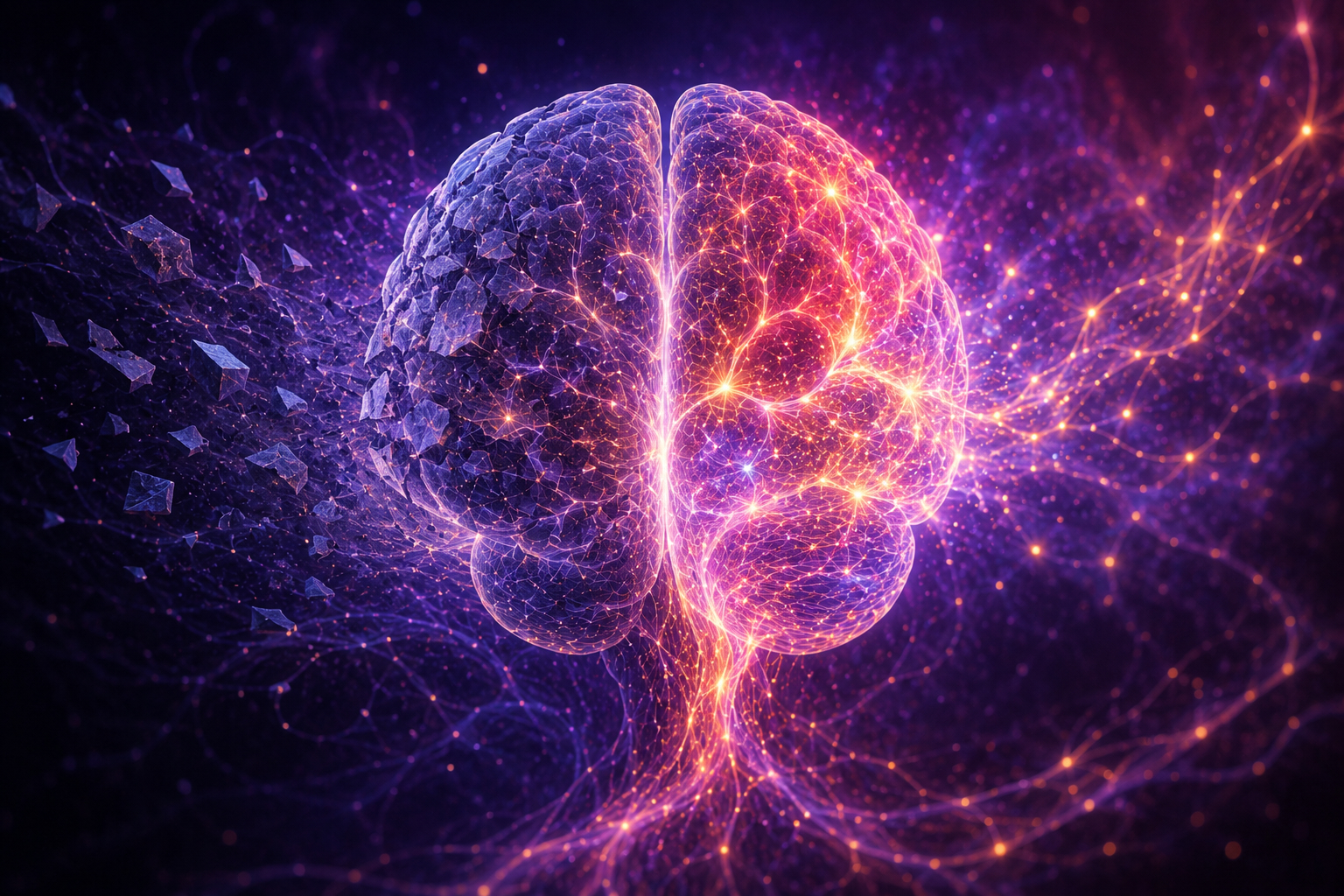
Modern neuroscience has fundamentally transformed the way we understand perception. Rather than functioning as a passive observer, the brain is constantly constructing our experience of reality. Every moment, it predicts what it expects to encounter, filters an overwhelming amount of sensory information, and creates an interpretation of the world that feels coherent, familiar, and meaningful.
This understanding shifts the conversation around manifestation from one centered on wishful thinking to one grounded in awareness, perception, and the remarkable adaptability of the human brain.
Within the philosophy of High Frequency Mind™, manifestation is not viewed as an attempt to force reality into becoming something different. Instead, it begins with understanding the relationship between awareness and the human experience. As awareness expands, we begin recognizing the conditioned patterns through which we have learned to perceive ourselves and the world. In doing so, we gain the opportunity to respond consciously instead of automatically.
The question is no longer whether you can manifest a different life. The question becomes whether you understand the mind that is already shaping the one you are living.
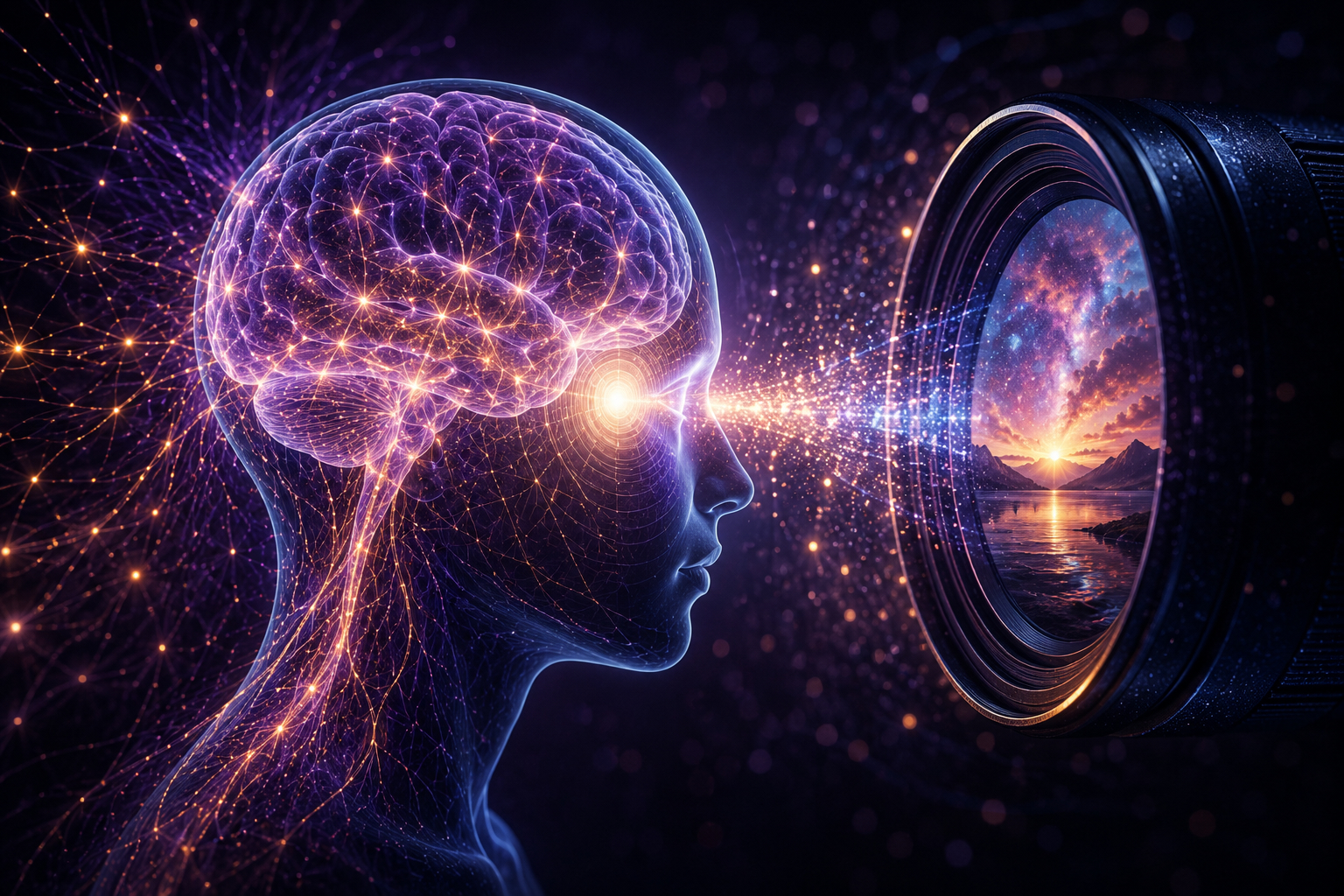
Your Brain Is Not a Camera
For generations, scientists believed the brain functioned much like a camera, faithfully recording the world exactly as it existed. It seemed reasonable to assume that our eyes captured reality and the brain simply processed the information.
Research over the past several decades has revealed a far more fascinating picture. Your brain does not wait for reality to explain itself. Instead, it continuously predicts what it expects to experience before you consciously become aware of it.
Imagine walking into your kitchen in the middle of the night. You don't carefully inspect every cabinet before knowing where they are. You don't consciously analyze the position of every chair before walking across the room. Your brain has already built an internal model based on years of previous experience. It predicts where objects should be, how the room is arranged, and even what actions you are likely to perform next.
Most of the time, those predictions are remarkably accurate. Occasionally they are not.
Perhaps someone moved a chair while you were away. Without thinking, you reach for it, only to discover it is no longer where you expected. That brief moment of surprise is known as a prediction error . Your brain predicted one outcome and reality presented another. It immediately updates its internal model so future predictions become more accurate.
This process occurs constantly. It influences how you interpret conversations, respond to uncertainty, recognize opportunities, and even understand your own identity.
What you experience is not simply reality itself. It is reality interpreted through the predictions your brain has spent a lifetime developing.
Predictive Processing: The Brain's Hidden Superpower
One of the most influential ideas in contemporary neuroscience is known as predictive processing.
According to this framework, the brain is not primarily reacting to the world. It is actively anticipating it.
Every second, your nervous system receives an extraordinary amount of sensory information. If your conscious mind attempted to analyze every sound, smell, movement, texture, and visual detail independently, you would become overwhelmed almost instantly. Instead, the brain performs an astonishing act of efficiency.
Using memories, learned experiences, beliefs, emotions, and previous outcomes, it generates predictions about what is most likely to happen next. Incoming sensory information is then compared against those predictions. When the prediction matches reality, very little conscious processing is required. When something unexpected occurs, the brain pays closer attention and updates its internal model.
This predictive system is one of the reasons human beings can navigate incredibly complex environments while devoting conscious attention to only a small fraction of the information available.
It is also one of the reasons change can feel so difficult. Your brain naturally favors what is familiar because familiarity has historically been associated with survival.
The Brain Was Built for Survival, Not Manifestation
One of the greatest misconceptions in personal development is the belief that the brain exists to make us happy.
From an evolutionary perspective, that has never been its primary objective. The brain's first responsibility is survival.
Every prediction it makes is ultimately attempting to answer one question:
"What is most likely to keep me safe?"
This helps explain why familiar emotional patterns often persist even when they no longer serve us.
- Someone who grew up expecting criticism may unconsciously anticipate rejection long after their environment has changed.
- Someone who learned that success required constant struggle may continue creating exhausting circumstances despite consciously wanting peace.
- Someone who experienced instability early in life may feel uncomfortable when life finally becomes calm because calmness itself is unfamiliar.
These patterns are not signs of personal failure. They are evidence that the brain is remarkably efficient at preserving what it has learned. Understanding this changes the way we approach manifestation.
Instead of asking why we cannot force ourselves to think differently, we begin asking how those predictive models were created in the first place.
That question leads us to one of the most important concepts within High Frequency Mind™: conditioning.
Long before you consciously chose your beliefs, your brain was learning. Every interaction, every relationship, every emotional experience, every success, every disappointment, and every message you received about yourself became part of the framework through which your brain now interprets reality.
Understanding those patterns is not about blaming the past. It is about recognizing that awareness creates the possibility of choice. And choice is where meaningful transformation begins.
Conditioning Is the Lens Through Which We Experience Reality
Every one of us enters the world with an extraordinary capacity to learn. Long before we develop language or consciously form beliefs about ourselves, our brains are collecting information about how the world works. We learn what feels safe, what feels threatening, how relationships function, and what we believe is possible. These experiences become the foundation upon which the brain builds its predictions.
Within the philosophy of High Frequency Mind™, these learned patterns are referred to as conditioning.
Conditioning is not inherently negative. It is one of the brain's greatest strengths. Without it, we would have to relearn how to navigate life every single day. It allows us to recognize faces, drive familiar routes, communicate with others, and respond quickly to changing environments.
The challenge arises when old predictions continue operating long after our circumstances have changed.
A childhood belief that you are not good enough may continue influencing career decisions decades later. A relationship that taught you not to trust may quietly shape every future connection. Experiences that once required protection can become unconscious filters through which you interpret every new situation.
Over time, these predictions become so familiar that they begin to feel like reality itself.
This is why awareness is so important.
Awareness does not immediately erase conditioning. Instead, it allows us to recognize that our thoughts, emotions, and reactions are not always objective reflections of reality. They are often reflections of the predictions our brain has learned to make.
Recognizing that distinction is one of the most transformative moments in personal growth because it introduces something many people have never considered.
Perhaps you are not experiencing reality exactly as it is. Perhaps you are experiencing reality through the lens of your conditioning.
Neuroplasticity: Why Lasting Change Is Possible
If conditioning shapes perception, does that mean we are forever limited by our past? Fortunately, neuroscience gives us a very different answer.
One of the most hopeful discoveries in modern brain science is neuroplasticity, the brain's remarkable ability to reorganize itself throughout life. Every experience, every new skill, every meaningful conversation, and every repeated behavior has the potential to strengthen or weaken neural pathways.
The brain is not fixed. It is continually adapting.
This does not mean transformation happens overnight. Deeply established patterns have often been reinforced thousands of times over many years. Meaningful change requires repetition, emotional engagement, and consistent practice. Yet every moment of awareness creates an opportunity to respond differently than we have before.
When those new responses are practiced repeatedly, they begin forming new predictive models.
This is why lasting transformation is rarely the result of a single insight. Instead, it emerges through the gradual integration of new experiences that teach the brain there is another way to perceive and respond.
Awareness Is Different from Thinking
Many people confuse awareness with positive thinking. They are not the same. Positive thinking attempts to replace one thought with another. Awareness steps back and observes both thoughts without immediately identifying with either one.
This distinction is central to the philosophy of High Frequency Mind™.
Conditioning says, "This is who I am."
Awareness asks, "Is that actually true?"
Conditioning reacts automatically. Awareness creates space. Conditioning seeks certainty. Awareness remains curious.
As awareness develops, something profound begins to happen. We recognize that thoughts are experiences occurring within consciousness rather than permanent definitions of who we are. We begin responding with greater intention instead of repeating familiar emotional patterns.
This is not about suppressing difficult emotions or pretending challenges do not exist. It is about developing the capacity to remain aware while experiencing the full complexity of being human.
The High Frequency Mind™ Perspective
High Frequency Mind™ is a contemporary philosophy of consciousness exploring the relationship between awareness and the human experience. It integrates insights from neuroscience, nervous system regulation, the subconscious mind, intuition, spirituality, and consciousness to better understand how conditioning influences perception and how awareness transforms the way we experience life.
At the center of this philosophy is The Architecture of the Infinite Self™, a framework exploring the relationship between Pure Awareness, the Infinite Self, the Human Experience, and the conditioned patterns that shape perception.
Rather than encouraging us to transcend our humanity, High Frequency Mind™ invites us to understand consciousness through it.
- The goal is not to become someone new.
- The goal is to remember what has always been true beneath the conditioning.
- The goal is not self-improvement.
- The goal is self-understanding.

Bringing the Science and Philosophy Together
Modern neuroscience provides extraordinary insight into how the brain predicts, filters, and interprets reality. High Frequency Mind™ expands this conversation by asking an equally important question.
If the brain is constantly shaping our perception, who is aware of those thoughts, emotions, and experiences? This question shifts the conversation from changing thoughts to understanding awareness itself.
As awareness grows, our relationship with the mind begins to change. We recognize conditioned patterns more quickly. We become less reactive, more intentional, and increasingly capable of responding from clarity rather than habit.
Transformation does not occur because reality suddenly changes around us. It begins because the way we perceive and respond to reality changes first.
Final Thoughts
The neuroscience of manifestation offers a perspective that is both scientifically grounded and deeply empowering. Rather than encouraging us to control every outcome, it invites us to understand the remarkable processes through which the brain constructs experience.
Predictive processing explains why the brain continually anticipates reality. Conditioning reveals how those predictions are shaped through experience. Neuroplasticity demonstrates that those patterns can change. Awareness provides the capacity to recognize them.
Together, these ideas reveal something profoundly hopeful. You are not limited to repeating the past simply because your brain has learned it.
The more aware you become of the patterns shaping your perception, the greater your capacity to choose how you respond to the present. Perhaps manifestation is not about becoming someone else. Perhaps it has always been about remembering who you are beneath the conditioning.
Continue Exploring
- Episode 15: Who Are You Beneath the Conditioning?
- Learn more about Lindsay Goodwin, The Consciousness Medium™
- Download the Infinite Self-Mastery eBook guide (my gift to you)
- Join the waitlist & get your first chapter of The High Frequency Mind Book
- Listen to more podcast episode on High Frequency Mind Podcast
Frequently Asked Questions
What is the neuroscience of manifestation?
The neuroscience of manifestation explores how predictive processing, attention, memory, emotion, conditioning, and neuroplasticity influence perception, behavior, and the way we experience reality.
Does the brain predict reality?
Current neuroscience suggests that the brain continuously generates predictions about incoming sensory information and updates those predictions through experience, a process commonly described as predictive processing.
What is predictive processing?
Predictive processing is a leading neuroscience theory proposing that the brain actively predicts and interprets sensory information rather than passively receiving reality exactly as it is.
What is neuroplasticity?
Neuroplasticity is the brain's lifelong ability to reorganize and strengthen neural pathways through learning, experience, and repeated behavior.
How does conditioning shape perception?
Conditioning develops through repeated experiences, beliefs, relationships, and emotional learning. These patterns influence how we interpret situations, make decisions, and respond to the world around us.
What is High Frequency Mind™?
High Frequency Mind™ is a contemporary philosophy of consciousness exploring the relationship between awareness and the human experience through neuroscience, nervous system regulation, the subconscious mind, intuition, spirituality, and consciousness.
What is The Architecture of the Infinite Self™?
The Architecture of the Infinite Self™ is the foundational framework of High Frequency Mind™. It explores the relationship between Pure Awareness, the Infinite Self, the Human Experience, and conditioned perception to better understand how consciousness is experienced through human life.
Scientific References
The following peer-reviewed research and scientific publications provide additional context for several of the neuroscience concepts discussed throughout this article, including predictive processing, prediction error, and neuroplasticity.
Burke, S. N., & Barnes, C. A. (2006). Neural plasticity in the ageing brain. Nature Reviews Neuroscience, 7(1), 30–40. https://doi.org/10.1038/nrn1809
Clark, A. (2013). Whatever next? Predictive brains, situated agents, and the future of cognitive science. Behavioral and Brain Sciences, 36(3), 181–204. https://doi.org/10.1017/S0140525X12000477
Keller, G. B., & Mrsic-Flogel, T. D. (2018). Predictive processing: A canonical cortical computation. Neuron, 100(2), 424–435. https://doi.org/10.1016/j.neuron.2018.10.003
den Ouden, H. E. M., Kok, P., & de Lange, F. P. (2012). How prediction errors shape perception, attention, and motivation. Frontiers in Psychology, 3, Article 548. https://doi.org/10.3389/fpsyg.2012.00548
About Lindsay Goodwin
Lindsay Goodwin, known as The Consciousness Medium™, is a consciousness teacher, intuitive medium, author, speaker, natural medicine clinician, and founder of High Frequency Mind™. Across nearly two decades of clinical and intuitive work with more than 2,000 private clients, she has explored how awareness, subconscious conditioning, nervous-system responses, and inner knowing shape the way people experience themselves, relate to others, make decisions, and practice conscious leadership.
Self-mastery is central to Lindsay’s work. She invites people to remember that we are pure awareness experiencing human life, to recognize the power within themselves, and to trust their inner knowing. A near-death experience in 2017 deepened this understanding and helped shape The Architecture of the Infinite Self, her framework for exploring who we are beneath learned roles, beliefs, and patterns. Through her books, podcast, private mentorship, and speaking, Lindsay helps people awaken to themselves and bring that awareness into the choices they make every day.
Meet Your Host & Author