Intuition vs. Anxiety: How to Tell the Difference and Trust Your Inner Knowing
Sep 01, 2026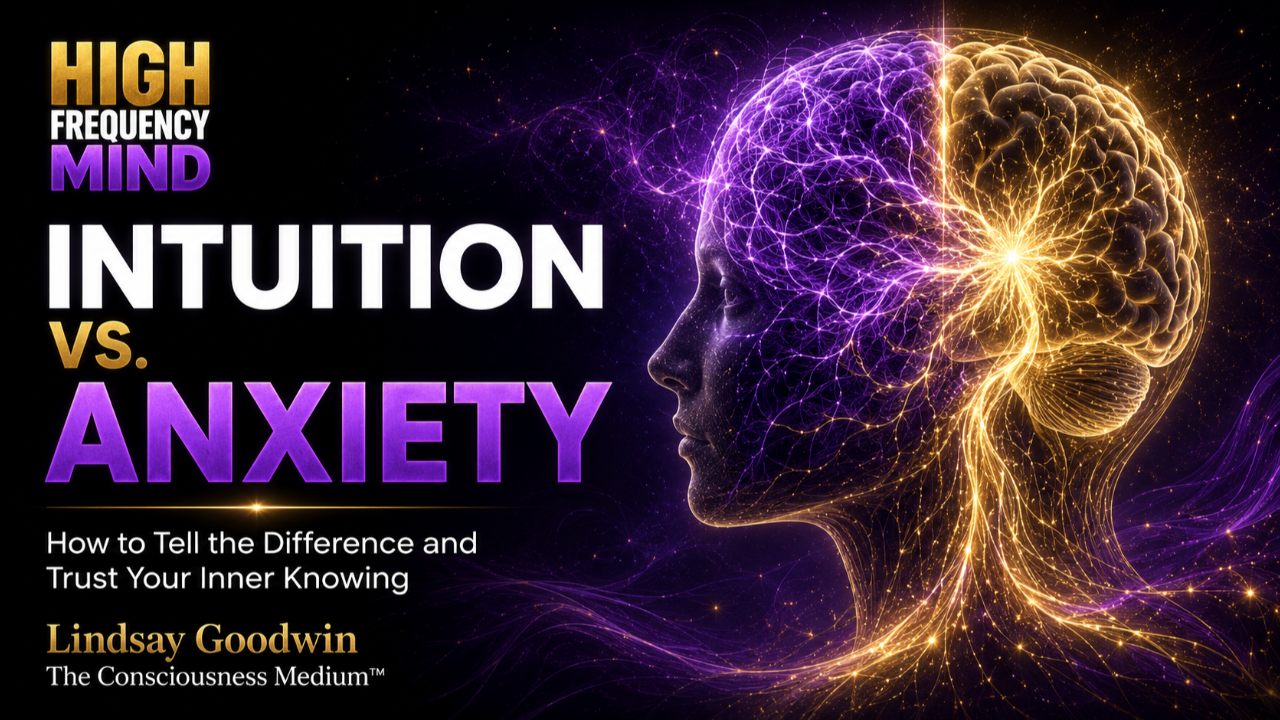
By Lindsay Goodwin, The Consciousness Medium™ & Founder of High Frequency Mind™
There are moments when something within you says, Do not go. This is not right. Wait. Choose differently. The message may arrive before you have evidence, before anyone else understands, and before your mind can explain why. Yet almost immediately, another voice may rise around it. It questions, analyzes, predicts, and searches for certainty. What began as a simple inner signal becomes a storm of competing possibilities.
This is where many people begin asking: Is this my intuition, or is it anxiety?
Intuition and anxiety can both appear through thoughts, emotions, physical sensations, dreams, or an immediate response to a person or situation. Both can interrupt your plans. Both can make it difficult to continue as though nothing has changed. This is why distinguishing between them is not always as simple as deciding that intuition feels peaceful and anxiety feels uncomfortable.
Sometimes intuition delivers a truth you do not want to hear. Sometimes anxiety becomes quieter after you avoid something, even when avoidance is not aligned with your deeper knowing. The difference is rarely found in one sensation alone. It is revealed through the quality, pattern, and energetic movement of the message.
Learning to recognize that difference is part of self-mastery. It is how you begin moving from fear-based reaction into a more conscious relationship with your own inner guidance.
What Is the Difference Between Intuition and Anxiety?
Intuition is a form of direct inner knowing. It often arrives before conscious reasoning has assembled an explanation. You may simply know that a decision, person, opportunity, or direction is aligned, or that it is not. The message can be subtle, but it has a certain completeness. It does not need to construct an elaborate story in order to exist.
Anxiety is more likely to organize itself around uncertainty, perceived threat, and the desire to prevent an unwanted future. It may repeat the same questions, create multiple imagined outcomes, or demand that you make a decision immediately so the discomfort will stop. Research on anxiety and decision-making describes how anxious states can heighten vigilance and influence how risk, uncertainty, and bodily sensations are interpreted. This connection between anxiety, bodily awareness, and decision-making helps explain why anxiety can sometimes feel like a powerful warning rather than a pattern of fear.
From the perspective of High Frequency Mind™, intuition is communication arising through a deeper field of awareness. Anxiety is part of the Human Avatar attempting to anticipate danger, reduce uncertainty, and protect you through what it has learned from the past. Neither part needs to be shamed. The deeper practice is learning which one is speaking before allowing either to lead.
Why Intuition and Anxiety Can Feel So Similar
Both intuition and anxiety can be experienced in the body. You may feel a tightening in your chest, a sensation in your stomach, a sudden change in energy, restlessness, resistance, or the unmistakable feeling that something is off. Because the body participates in both intuitive perception and protective responses, physical sensation alone does not always identify the source.
Your history also shapes the way you interpret those sensations. If you have learned that conflict leads to rejection, speaking honestly may produce anxiety even when your intuition is guiding you toward the conversation. If previous relationships taught you to question yourself, a healthy connection may initially feel unfamiliar rather than immediately safe. If you have been rewarded for overworking, rest may feel wrong even when your inner knowing is asking you to stop.
This is why awareness of conditioning matters. A sensation may be real while the meaning assigned to it is inherited, learned, or based on a previous experience. Exploring the difference between awareness and conditioning can help you recognize that not every thought or feeling is an instruction. Sometimes it is information revealing how your Human Avatar has learned to survive.
Are You Consciously Aware or Anxiously Reacting?
The difference between being consciously aware and anxiously reacting is not whether you feel emotion. Conscious awareness allows you to notice a thought, sensation, or inner message without immediately allowing it to define reality or dictate your next move. An anxious reaction compresses the space between perception and response. The feeling begins to seem like proof, and relief can become more important than clarity.
When you are consciously aware, you may still feel uncertain, activated, or afraid. Yet some part of you remains able to observe what is happening. You can ask whether the reaction belongs to the present moment, reflects a familiar pattern, or surrounds a deeper intuitive knowing that has not changed.
When anxiety is leading, the mind often searches for a final answer that will remove uncertainty. It may replay the same evidence, seek repeated reassurance, or create a new question each time the previous one is answered. The urgency itself becomes part of the message.
Sometimes you are both conscious and anxious. Awareness does not require the anxiety to disappear before you can listen within. It creates enough inner space to recognize the anxiety, understand what it is protecting, and discern whether another knowing remains present beneath it.
This is the practical movement of observer consciousness: noticing the reaction without abandoning yourself inside it.

How Anxiety Speaks
Anxiety often speaks through urgency. It tells you that you must know now, decide now, fix the situation now, or obtain reassurance before you can return to yourself. When one question is answered, another may appear. The mind attempts to close every opening through which uncertainty could enter.
Its language commonly moves toward imagined futures: What if I make the wrong choice? What if they leave? What if I miss my opportunity? What if this feeling means something terrible is about to happen? The questions may sound like discernment, but their purpose is often not genuine inquiry. Their purpose is to create a level of certainty that life cannot provide.
Anxiety can also become circular. It replays conversations, searches for hidden meanings, revisits the same decision, and asks other people to confirm what it cannot settle internally. Even after reassurance arrives, the relief may be temporary because the deeper pattern has not been resolved.
The National Institute of Mental Health identifies excessive worry, difficulty controlling worry, restlessness, feeling on edge, trouble concentrating, muscle tension, fatigue, and sleep disturbance among the possible signs of generalized anxiety. These experiences exist on a spectrum, and occasional anxiety is part of being human. When anxiety becomes persistent or interferes with daily life, professional support can become an important part of caring for your whole being.
How Intuition Speaks
Intuition often speaks more simply. It may arrive as a sentence, image, feeling, dream, bodily signal, or immediate awareness that seems complete before the mind begins interpreting it. The original message might be only a few words: Call her. Wait. This is the one. Something is being withheld. You have outgrown this.
The message may be uncomfortable, but it usually does not require a continuous stream of catastrophic possibilities to maintain its authority. It can remain present beneath the mental noise without becoming louder or more dramatic. When you return to it after rest, emotional regulation, or time away from the situation, the essence often remains the same.
Intuition does not always promise the easiest path. It may guide you toward a boundary that disappoints someone, an opportunity that stretches your identity, or an ending your mind has been trying to avoid. Its purpose is not to preserve every existing structure. It may be leading you toward greater internal coherence.
Inner knowing also respects autonomy. It does not need to control another person, force an outcome, or turn every synchronicity into proof. The more deeply you trust yourself, the less you need intuition to provide absolute certainty about the future.
Intuition vs. Anxiety: Common Differences
| Intuition | Anxiety |
|---|---|
| Often arrives as a direct impression or knowing | Often arrives as repeated questions and imagined scenarios |
| May be uncomfortable, but feels internally clean | Feels mentally tangled, urgent, or difficult to satisfy |
| Tends to remain consistent after you become calmer | May change as new fears or possibilities appear |
| Offers direction without requiring total certainty | Seeks certainty, reassurance, prediction, or control |
| Can acknowledge complexity while preserving clarity | Often narrows attention around threat or the worst outcome |
| Does not need to diminish your worth | May become entangled with self-doubt, shame, or fear of failure |
These differences are invitations for observation, not rigid laws. Your intuition has its own language, and your anxiety has its own patterns. The goal is not to force every experience into a chart. It is to become intimate enough with your internal world that you recognize the energetic signature of each.
Is Intuition Always Calm?
No. One of the most misleading teachings about intuition is that it will always feel peaceful.
Intuitive information can activate fear because it may challenge the identity, attachment, or future your mind has been protecting. You can intuitively know that a relationship is complete and still feel terrified of leaving. You can know that you are meant to share your work and still feel anxiety when you become visible. You can sense that a new direction is aligned and still grieve the version of your life that must be released.
The intuitive message and the emotional response to the message are not always the same thing.
This distinction is essential. The original knowing may be clear, while the thoughts that follow are fearful. If you interpret the fear as proof that the intuition is wrong, you may abandon the guidance simply because your Human Avatar needs time to integrate what your higher awareness has already revealed.
Ask yourself: What did I know before I became afraid of what that knowing might require?
Can Anxiety Feel Calm?
Yes. Anxiety does not always appear as panic. It can become a highly organized strategy of control. Overplanning, perfectionism, repeatedly seeking spiritual signs, researching every possible outcome, or delaying a choice until you feel completely certain can all appear thoughtful and responsible while still being driven by fear.
Avoidance can also create temporary calm. Saying no to an aligned opportunity may relieve the anxiety of being seen. Remaining silent may relieve the anxiety of conflict. Staying in a familiar pattern may relieve the anxiety of change. Relief tells you that activation has decreased; it does not always tell you that the decision was aligned.
This is why the deepest question is not simply, Which option makes me feel calmer right now? It is: Which choice allows me to remain in relationship with myself?
How Conditioning Can Masquerade as Intuition
Subconscious conditioning speaks with the authority of familiarity. A pattern repeated for years can feel true simply because it has become automatic.
If you learned to monitor everyone else's emotional state, hypervigilance may feel like intuition. If you experienced betrayal, suspicion may present itself as discernment. If love was inconsistent, emotional unavailability may feel magnetically familiar while consistency feels strangely flat. If your value became attached to achievement, an inner demand to keep producing may be mistaken for guidance.
This does not mean your perceptions are meaningless. It means the signal may be moving through a system shaped by memory. Understanding why subconscious patterns keep repeating allows you to receive the information without automatically accepting the first interpretation.
Discernment asks you to hold two truths at once: your inner experience deserves attention, and your first explanation may not be the only explanation.
The Body Is a Messenger, Not a Verdict
Your body can offer extraordinary information. It can register subtle shifts in safety, connection, incongruence, attraction, resistance, and energy before the conscious mind understands what it has perceived. Yet the body also carries learned responses. A racing heart can accompany danger, excitement, visibility, attraction, memory, or transformation.
Instead of asking one sensation to deliver a final answer, become curious about its pattern. Does the contraction appear whenever you prepare to speak honestly? Does it occur around one particular person regardless of what they say? Does the feeling soften after sleep or become clearer? Does it lead you toward self-respect, or does it pull you into compulsive checking and self-abandonment?
Research on interoception, which is the perception of signals arising within the body, shows that bodily awareness and anxiety have a complex relationship. More sensation does not automatically mean more accuracy. The meaning you assign to the sensation matters. This is why embodied intuition requires both sensitivity and awareness.
Your body is part of the conversation. It does not have to carry the entire burden of interpretation alone.

A Conscious Practice for Telling Intuition From Anxiety
When you cannot tell whether you are hearing intuition or anxiety, do not force an immediate answer unless the situation truly requires one. Create enough space for the first signal to separate from the mental response surrounding it.
-
Name the original message. Before explaining it, write the first impression in one sentence. What did you know or sense before analysis began?
-
Name the story that followed. Write down the predictions, fears, and imagined consequences that appeared after the original message.
-
Regulate before interpreting. Breathe, walk, rest, move your body, step away from the conversation, or return to the decision after sleep. Regulation does not invalidate the message; it helps reduce the noise around it.
-
Notice the demand beneath the thought. Is the voice asking for alignment, or is it demanding certainty, reassurance, control, or immediate relief?
-
Look for the repeating pattern. Have similar fears appeared in other relationships or decisions? Repetition may reveal conditioning that deserves awareness.
-
Return to the question later. Intuition often remains coherent across time. Anxiety may generate a different emergency each time uncertainty returns.
-
Take the smallest aligned step. You do not always need the entire future. One honest conversation, boundary, pause, question, or action may reveal the next layer of truth.
This practice helps create space between what you perceive and how you respond. That space is also explored in Are You Your Thoughts?, because discernment begins when you recognize that you can witness a thought without immediately allowing it to become reality.
When You Still Cannot Tell
Sometimes intuition and anxiety are present together. You may be receiving a genuine inner signal while your nervous system reacts to what the signal could mean. You may also be sensing something important while old conditioning shapes the story you build around it.
In those moments, release the demand to label the experience perfectly. You can honor the signal without making an irreversible decision from activation. You can gather information without abandoning your knowing. You can ask for support without surrendering your authority.
True self-trust is not the belief that you will interpret every message flawlessly. It is the knowing that you can remain present, make the clearest choice available, learn from what unfolds, and return to yourself if the path changes.
You are not building a life in which uncertainty disappears. You are becoming the version of yourself who no longer needs uncertainty to disappear before you can hear your own soul.
Intuition, the Higher Self, and the High Frequency Mind™
Within The Architecture of the Infinite Self, intuition exists at the meeting place between Pure Awareness and the Human Avatar.
The Infinite Self is the awareness capable of perceiving beyond the identity, fears, and conditioning of the moment. The Human Avatar is the embodied self with a brain, body, nervous system, subconscious mind, history, emotions, relationships, and physical senses. The High Frequency Mind™ is the Conscious Navigator. It is the capacity to move between these dimensions with increasing awareness.
The goal is not to silence the Human Avatar so that only the higher self can speak. Your fear may contain information. Your anxiety may reveal where uncertainty, memory, or self-protection is active. Your body may illuminate a pattern your conscious mind has not yet recognized.
But these experiences do not have to become the sole authority directing your life.
The High Frequency Mind learns to listen without becoming consumed, to feel without immediately reacting, and to honor inner knowing without turning it into another demand for certainty. This is how intuition matures from something you occasionally receive into a relationship you consciously embody.
If you are moving through a deeper stage of awakening, you may also resonate with 9 Signs of a Second Spiritual Awakening, where self-trust begins replacing the need for constant external confirmation.

Trusting Your Inner Knowing
Your intuition does not need to compete with the loudest thought in your mind. It often waits beneath the noise, unchanged by the stories moving above it.
Each time you pause before reacting, question a familiar fear, honor a boundary, or remain present with uncertainty, you strengthen your capacity to hear it. Each time you stop asking another person to override what you already know, you restore a part of your inner authority.
You may still experience doubt. You may still become activated. You may still ask for perspective. The presence of fear does not mean you have lost your intuition, and the presence of intuition does not mean you have transcended your humanity.
You are learning to let your consciousness and your humanity communicate.
The deeper invitation is not to become someone who never feels anxiety. It is to become someone who can recognize anxiety without automatically allowing it to speak as destiny.
Frequently Asked Questions About Intuition vs. Anxiety
How can I tell if it is intuition or anxiety?
Intuition often arrives as a direct, coherent impression that remains relatively consistent over time. Anxiety is more likely to involve urgency, repetitive thinking, imagined negative outcomes, and a strong need for certainty or reassurance. Because both can involve bodily sensations, consider the entire pattern rather than relying on one feeling alone.
What is the difference between being consciously aware and anxiously reacting?
Conscious awareness allows you to observe a thought, sensation, or inner message before deciding what it means or how to respond. Anxious reacting is more likely to create urgency, repetitive analysis, reassurance-seeking, or a need to eliminate uncertainty immediately. You can still feel anxiety while remaining consciously aware of what is happening.
Can intuition feel like anxiety?
Yes. Intuitive information can trigger anxiety when it challenges an attachment, identity, relationship, or expected future. The original intuitive message may feel clear while the emotional and mental response to what it requires feels fearful.
Is intuition always a calm feeling?
No. Intuition may deliver uncomfortable information. Its clarity is more significant than whether the message feels pleasant. Intuition can coexist with grief, fear, excitement, or uncertainty while still retaining a simple and consistent essence.
Can overthinking block intuition?
Overthinking can make intuition more difficult to recognize because repeated analysis surrounds the original signal with competing stories. Pausing, regulating the nervous system, writing down the first impression, and returning to the question later can help separate the initial knowing from the thoughts that followed.
How do I strengthen and trust my intuition?
Begin by noticing how your intuition uniquely communicates and recording what you sense before seeking external opinions. Observe which impressions remain consistent, take small aligned actions, and reflect on what unfolds. Self-trust grows through relationship and experience, not through demanding perfect certainty from every decision.
Ready to Deepen Your Relationship With Your Inner Knowing?
If you are learning to distinguish intuition from anxiety, recognizing where subconscious patterns influence your decisions, or feeling called to trust what you already know, you do not have to move through that process alone.
In a private session with Lindsay Goodwin, you can explore the deeper pattern beneath what you are experiencing, receive intuitive insight, and reconnect with the awareness that exists beyond fear and conditioning.
Book a Session and Work With Lindsay
You can also go deeper into consciousness, intuition, and self-mastery through The High Frequency Mind.
About Lindsay Goodwin
Lindsay Goodwin, known as The Consciousness Medium™, is a consciousness teacher, intuitive medium, author, speaker, natural medicine clinician, and founder of High Frequency Mind™. Across nearly two decades of clinical and intuitive work with more than 2,000 private clients, she has explored how awareness, subconscious conditioning, nervous-system responses, and inner knowing shape the way people experience themselves, relate to others, make decisions, and practice conscious leadership.
Self-mastery is central to Lindsay’s work. She invites people to remember that we are pure awareness experiencing human life, to recognize the power within themselves, and to trust their inner knowing. A near-death experience in 2017 deepened this understanding and helped shape The Architecture of the Infinite Self, her framework for exploring who we are beneath learned roles, beliefs, and patterns. Through her books, podcast, private mentorship, and speaking, Lindsay helps people awaken to themselves and bring that awareness into the choices they make every day.
Meet Your Host & Author