Episode 19: Becoming the Observer | From Thought to Inner Knowing, Part 2
Sep 15, 2026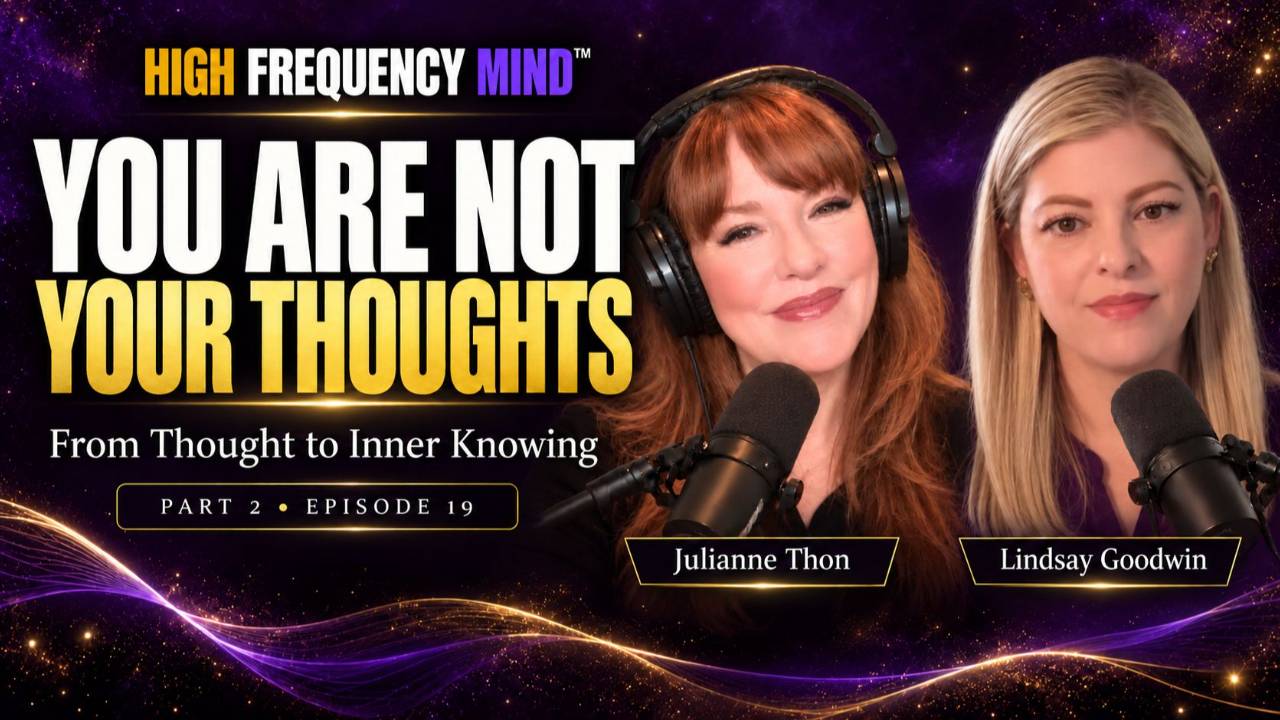
High Frequency Mind™ · Season 2, Episode 19 · With Julianne Thon
From Thought to Inner Knowing, Part 2 of 4 · Episode released September 14, 2026 · 44:06
By Lindsay Goodwin, The Consciousness Medium™
If you can observe your thoughts, who is the one watching?
A familiar thought can arrive so quickly that it feels like the truth about who you are. You are not ready. You are not enough. Something will go wrong. Before you have questioned it, that thought may already be shaping your next choice.
In Part 2 of From Thought to Inner Knowing, Lindsay Goodwin and Julianne Thon explore a different relationship with the mind: becoming the observer. Their conversation asks what changes when you can notice a thought, feel an emotion, and recognize a pattern without allowing it to define your whole identity.
The observer, as discussed in this episode, is the awareness that notices thoughts, emotions, and reactions. Lindsay describes this through the spiritual language of the higher self and soul self. Julianne brings the conversation into daily practice: step back, notice what is happening, and consider how you might respond differently.
Listen to Episode 19: From Thought to Inner Knowing, Part 2
Listen on Buzzsprout · Follow on Spotify · Follow on Apple Podcasts · Subscribe on YouTube
New to the series? Begin with Part 1: Spiritual Awakening and the Higher Self—How to Trust Your Inner Knowing.
Episode highlights
- What the observer is and how it differs from the thinking mind.
- Recognizing learned conditioning without treating every thought as your identity.
- Observing yourself without slipping into criticism or judgment.
- Meeting familiar emotional loops with awareness and a different response.
- The distinction between emotional neutrality, numbness, and avoidance.
- Lindsay and Julianne’s spiritual perspectives on intuition, energetic sensitivity, and past-life patterns.
- Why the ego has a place in the human experience.
- Simple ways to bring observation into everyday choices and relationships.
What if you are not every thought you think?
Lindsay opens the discussion by describing the thinking mind as the place where conditioning often repeats itself: what a parent said, how a family has always done something, or the rules you learned about what is possible.
Becoming the observer creates an opportunity to notice those messages. A thought may be familiar without being a direction you want to follow. An emotion may be present without being the only information available to you.
Julianne describes the shift through ordinary bodily experiences: noticing a clenched jaw or a pit in the stomach, then asking what is happening. Instead of being completely immersed in a reaction, you begin relating to it with curiosity.
For a deeper introduction, explore What Is Observer Consciousness? 5 Steps to Observe Your Mind.
Conversation highlights: Lindsay Goodwin and Julianne Thon
The following highlights summarize the conversation. Quotation marks identify brief direct excerpts; the surrounding text is paraphrased.
Julianne: Ask a different question
Julianne offers the question, “How can I do this differently?” It shifts attention from condemning yourself for having a thought to considering the response you want to practice.
For Julianne, observation is not about avoiding every uncomfortable feeling. It is a way to learn from the experience while deciding whether you want to keep nurturing the same pattern.
Lindsay: Notice the moment of choice
Lindsay brings the conversation to the moment when a familiar emotional spiral begins. You recognize the route you normally take, and you consider another response. She describes that recognition as part of self-mastery: becoming less automatically pulled into reactions that once dominated your experience.
The conversation also acknowledges that this takes practice. Noticing a pattern again does not erase the awareness you have already developed.
Both: Observation is different from self-criticism
Lindsay asks how people can distinguish observing themselves from critiquing themselves. Julianne points to the difference between asking how to work through something and asking why you are not good enough to work through it.
The first question leaves room for discovery. The second turns the experience into a verdict about your worth. Lindsay adds that recognizing self-judgment can itself become part of the process of awakening.
Observing your emotions does not mean becoming numb
One of the most useful distinctions in this episode is between neutrality and numbness. Lindsay describes neutrality as becoming less reactive to experiences that previously pulled you into a familiar loop.
Julianne adds an important nuance: some people use emotional disconnection to avoid a confrontation, a feeling, or something they do not want to face. A lack of visible reaction does not, by itself, reveal what is happening internally.
In their discussion, being the observer still leaves room for feeling. Joy, anger, grief, love, and uncertainty remain part of the human experience. The invitation is to become more aware within that experience, rather than to allow only the emotions that seem spiritually acceptable.
You can ask: Am I present with what I feel, or am I trying not to feel it? That question offers a starting point for reflection, rather than a label you have to place on yourself.
Intuition, conditioning, and the voices within
Near the end of the episode, Lindsay suggests beginning with the different qualities of your inner dialogue. She describes intuitive guidance as nurturing and connected, while conditioned thinking may repeat inherited rules or fear-based predictions.
She then widens the question: what is the awareness capable of noticing both? That is the observer the conversation keeps returning to.
Lindsay and Julianne also explore spiritual interpretations involving energetic sensitivity, ancestral influences, and past lives. These parts of the conversation express their perspectives; they do not establish where a particular thought originated. You can reflect on a thought’s meaning without needing certainty about its source.
Continue with Intuition vs. Anxiety: How to Tell the Difference and Trust Your Inner Knowing.
The ego has a place in your human experience
This episode does not end with a call to eliminate the ego. Julianne explicitly makes room for its role, and Lindsay questions the idea that spiritual growth means escaping the human experience.
The question becomes how you relate to that experience. Can you recognize a protective reaction, listen to your inner dialogue, and make a choice with greater awareness? Can you enjoy being human without needing every reaction to become the center of the story?
Lindsay offers the metaphor of watching a movie: you can be moved by the story while remembering that you are also the one watching it. Here, that image is an invitation to perspective and participation—not withdrawal from your life.
A simple observation practice to take into your day
This reflection brings together suggestions from the conversation; it is not a verbatim guided exercise from the recording.
- Notice the thought. What is your mind saying right now?
- Notice the feeling. What emotion or physical sensation comes with it?
- Listen to the tone. Are you exploring the experience or criticizing yourself for having it?
- Ask what you want to do differently. Consider one response you could choose in this moment.
- Practice again. If the pattern returns, begin with observation again. There is no requirement to do this perfectly.
Julianne also suggests beginning the day with gratitude and an intention to observe. The value of the practice lies in returning to awareness throughout ordinary life, including the moments when you notice yourself reacting.
Episode chapters
- 00:00 — Opening reflection: choosing differently
- 00:23 — Lindsay introduces Part 2
- 01:44 — Awakening beyond identity
- 03:09 — What is the observer?
- 05:17 — Noticing thoughts, fear, and physical sensations
- 08:13 — Energetic sensitivity and the source of thoughts
- 09:41 — Ancestral patterns and spiritual interpretations
- 11:34 — Julianne’s perspective on past lives and hypnosis
- 16:58 — How can I respond differently?
- 19:33 — Why observation takes practice
- 21:47 — Observing yourself versus criticizing yourself
- 24:11 — Emotional reactions and strengthening the observer
- 28:01 — Neutrality, numbness, and avoidance
- 31:17 — Turning awareness into action
- 33:35 — Gratitude and daily intention
- 36:58 — Intuitive and conditioned inner dialogue
- 41:24 — Why the ego still has a role
- 43:05 — Final reflections and following the show
Questions from this conversation
What does it mean to become the observer?
In this episode, becoming the observer means noticing thoughts, emotions, and habitual reactions without automatically treating them as the whole of who you are. Lindsay and Julianne explore this through awareness, self-reflection, and their spiritual understanding of the higher self.
How is observing different from judging yourself?
Observation asks what is happening and what you can learn. Self-judgment turns the experience into a statement that something is wrong with you. Noticing that judgment gives you another opportunity to respond with curiosity.
Does being the observer mean avoiding emotions?
No. The conversation makes room for the full emotional experience. Julianne distinguishes observation from shutting down or avoiding feelings, while Lindsay describes becoming less automatically reactive.
Where should I begin with this series?
Begin with Part 1, Episode 18, which introduces thought, conditioning, intuition, and the higher self. Episode 19 continues that discussion through the observer. Follow the show for the remaining conversations in the four-part series.
Continue your exploration
- Are You Your Thoughts?
- What Is Consciousness? Awareness, the Brain, and the Nature of Experience
- Episode 17: Introspective Hypnosis with Julianne Thon
- Explore The High Frequency Mind book
- Download the complimentary Infinite Self-Mastery Guide
- Explore private work with Lindsay
About Lindsay and Julianne
Lindsay Goodwin, known as The Consciousness Medium™, is a consciousness teacher, intuitive medium, author, speaker, natural medicine clinician, and founder of High Frequency Mind™. Across nearly two decades of clinical and intuitive work with more than 2,000 private clients, she has explored how awareness, subconscious conditioning, nervous-system responses, and inner knowing shape the way people experience themselves, relate to others, make decisions, and practice conscious leadership.
Self-mastery is central to Lindsay’s work. She invites people to remember that we are pure awareness experiencing human life, to recognize the power within themselves, and to trust their inner knowing. A near-death experience in 2017 deepened this understanding and helped shape The Architecture of the Infinite Self, her framework for exploring who we are beneath learned roles, beliefs, and patterns. Through her books, podcast, private mentorship, and speaking, Lindsay helps people awaken to themselves and bring that awareness into the choices they make every day.
Julianne Thon joins Lindsay as co-host of From Thought to Inner Knowing. In this conversation, she draws on her experience with hypnosis, education, and spiritual exploration. Explore Julianne’s podcast work at Souls on Tap.
Follow, review, and share High Frequency Mind
If this conversation shifted how you see your thoughts, stay with us for what comes next. Follow High Frequency Mind™ so you do not miss the next part of the series or the next guest conversation.
Leave a rating on Spotify, write a review on Apple Podcasts, and share this episode with someone exploring their own awakening. Your support helps others discover the show and helps us keep creating these conversations.
- Follow on Spotify
- Listen and review on Apple Podcasts
- Watch and subscribe on YouTube
- Find your favorite listening app
- Explore the podcast and articles
- Follow Lindsay on Instagram
- Connect with Lindsay on LinkedIn
Episode 19 transcript: From Thought to Inner Knowing, Part 2
This transcript of the publicly released Episode 19 recording has been lightly formatted for readability. Automated transcription may contain errors; the recording is the best reference for exact wording.
Julianne Thon: And then asking the self, not how could I do this better, but asking the self, how can I do this differently? How can I not avoid thinking those thoughts, but how can I turn these thoughts into the person that I really am, the higher self? So I guess you would learn from that experience. You would actually learn from that thought.
Lindsay Goodwin: That's where change happens. In the moment when you could choose something comfortable of spiraling, of getting angry about and you choose to No, I'm not doing this today. I'm I'm not interested. And that's when the pattern clears.
Lindsay Goodwin: What becomes possible when you begin to observe your own thoughts and recognize the awareness within you that is doing the observing? Welcome to High Frequency Mind, and I'm Lindsay Goodwin, the Consciousness Medium, and I'm joined by my co-host Julianne Thon for our part two of our four-part series. And today we're exploring the observing of the self.
Lindsay Goodwin: How to recognize the thoughts and emotions that could be shaping your experience and move through familiar reactions and create space for more of a more conscious response. We'll also explore the difference between observing yourself and judging yourself and how to bring this awareness into your relationships, your choices, and everyday life. So take a breath, settle in, and let's continue the conversation.
Julianne Thon: And today we continue our four part series, The Awakening Within From Thought to Knowing. In our last episode, we explored the question, who is thinking your thoughts? and opened the conversation around the mind, conditioning, and the realization that we may be more than the constant stream of thoughts we identify with. Which brings us to today's episode, the observer effect, awakening beyond identity.
Julianne Thon: Because once we begin noticing our thoughts and our emotions and our patterns, we also begin discovering that there's a deeper awareness when observing all of it. Today we'll explore what the observer really is, how awareness begins shifting subconscious patterns, and what happens when we stop identifying with every thought and emotion that passes through us. So wherever you are on your journey, we invite you to listen.
Julianne Thon: with curiosity and an open mind. Let's get started. Hi, Lindsay.
Lindsay Goodwin: Hi, Julianne. It's so great to be back having this conversation. I'm so excited about this today.
Julianne Thon: I have too, as as usual. But again, it is my honor to collaborate with you, Lindsay. You are an amazing individual.
Lindsay Goodwin: same. Same same absolutely feel the same. It's mutual.
Julianne Thon: Yeah. Okay, so jumping right in.
Julianne Thon: So when we're talking about the observer, I think it would be great for us to discuss what is the observer and how is it different from the thinking mind?
Lindsay Goodwin: Yeah, that's often a question I feel like, you know, you've probably asked yourself on this journey, as you know, obviously that's why we're having this conversation because we've come up with ideas and perspectives of what we really see it to be through our own transformations. And so what I really find is is that the thinking mind is more of that human, the ego, I guess some people would call it. it would be the patterning.
Lindsay Goodwin: The thinking I should do this or I shouldn't do that, or my mom told me to do this, or my grandpa did it this way. Right. You know, it's the conditioning. Or what yes, yes, yes. So well, like the observer is more of that infinite awareness that's observing the whole journey. And I like to call that the soul self, the higher mind, the higher self.
Julianne Thon: But if this happens
Lindsay Goodwin: Whatever resonates, there's all different kinds of names, as you know. so it's really learning how to tap in and really align with the observer. And intuition first, logic second, and really understanding that you're not every thought, that there are thoughts that come in. You don't have to resonate with every thought. It's really about
Lindsay Goodwin: observing much of what's going on.
Lindsay Goodwin: So what I what I wanna know from you, Julianne, is I wanna think about this. after what I just said, how do you feel about when someone might become first aware of their thoughts? What do you think typically shifts for them? I'm curious to know how you what you would say about that.
Julianne Thon: So I think the typical mind, the th the typical three D mind, let's call it. Somebody, as you said, who is immersed in ego. And that's not necessarily a bad thing unless we let that overtake who we are. So I think what happens when that ego and that and the three D mind starts to become aware of their thoughts, they will see a lot of fear.
Julianne Thon: They will they will understand that there is a basic insecurity that is going on there, that they believe that they're not enough. And that's why they come up with these, my God, my God, answers. Like, how am I gonna do this? I'm not good enough to do this, but what if this happens? What if this doesn't happen? When you begin to shift your thinking into acknowledging.
Julianne Thon: those thoughts and what it is that you're thinking. You have the capacity and the ability to step back and to literally look at your thoughts. To literally ask yourself, why am I feeling this this pit in my stomach? Why am I clenching my teeth when I'm when I'm trying to work through this this
Julianne Thon: whatever it is I'm trying to work through. And we've talked about this before, Lindsay, from a Zen perspective, the goal or the process, I don't like the word goal, the process is in understanding how you step back, allow yourself to to feel these feelings, allow yourself to think these thoughts, see the fear, see the anger.
Julianne Thon: See the apprehension, whatever it is that's negatively affecting you, and ask yourself, well, why? Why am I thinking these thoughts? Why am I feeling those feelings? And as the observer, you are watching the self. And then you can begin to translate that into, huh? That's really interesting. I'm feeling this way because of.
Julianne Thon: A B C, fill in the blank, whatever. So you are almost looking at yourself as an objective overseer. Mm-hmm. So I I think that that is the beginning of that shift is the ability to step back and observe your thoughts and your feelings instead of immersing yourself in that drama, or as I heard somebody refer to it the other day, the drama trauma.
Julianne Thon: Yeah.
Lindsay Goodwin: How do you feel though about because often the way that I understand it is that energy can very much come into your own energy field from others. And there's all kinds of thoughts in the ether. And it's really that idea of whether or not you identify with them.
Lindsay Goodwin: So maybe do you agree that maybe some thoughts might not necessarily be your thoughts? They might not be from your own experience. Yeah.
Julianne Thon: Absolutely, I do. I'm glad you brought this up because this is important because we all do it. Mm-hmm. Those of us who are sensitive to energy and and allow ourselves to be, which is a good thing, if you are going through the process of the observer and you are stepping back, you will more clearly see that these are not in fact your thoughts. They are not in fact your thinking.
Julianne Thon: But if it's something that, if it's a fear-based thought that somebody else has brought into your energy and you've taken it because it resonates with you, the question then and the pro through the process of the observer is to ask the self, where did this come from? Why did I why does this resonate with me?
Lindsay Goodwin: Mm-hmm. Yeah, absolutely. I love that. What do you feel about thoughts? And because I believe that we know through science that we have physical DNA, right? That like nature just keeps going. And so we have cells and and DNA in our body that our ancestors also had. So we know that cells and energy carry memory. And so what about for
Lindsay Goodwin: Us in the physical experience, that maybe some of the thoughts that we could possibly have are like from trauma that maybe isn't even ours. Maybe it was from an ancestor. So I guess what I'm getting at is how do you feel about how someone might be able to identify if that is theirs from their experience of trauma or if that could be someone else? I guess maybe an ancestor or someone that is rel is.
Lindsay Goodwin: is a relative and connected to genet genetically in some way. I guess for me, I would think it would be just intuition, like a knowing of that, okay, I remember this feels like something that resonates with me, whereas this thought feels like it's there and I recognize it, but it doesn't feel like that relates to me. So maybe that's something that I'm not supposed to be paying attention to. Not that I'm not
Lindsay Goodwin: Supposed to be aware of it because I think it's important to be aware of things, but not giving it energy in a way that we get entangled in it. Like if you're getting entangled in a web, you know, a spider, you know, you you you don't want to get stuck in the web. So you know that it's there, but I guess I don't really know exactly. Like I'm just I'm brainstorming here, like
Julianne Thon: No, and you you bring up some good some good points, Lindsay. First of all, are are you also talking about the possibility of learned behavior through past lives or
Lindsay Goodwin: Right, that too. That too. I know that's an expertise of yours. Well
Julianne Thon: Well, so that's that's that's something that's slightly different, but it can affect us in the same way. You're absolutely right when you brought when you brought that up. that would be a point in time for the individual to probably find somebody who does hypnotherapy. and to ask work w with their soul because it's the soul that needs to heal. And if there is some trauma from a past life.
Julianne Thon: hypnotherapist that is good at what they do and and can help your soul take you to a past life if that's what it needs to do in order to heal. Then you can observe which mandate you may have made back in that time that you lived. maybe it was that you decided that you were rich once and because you were rich you lost everybody that you loved. And before you died in that lifetime you said, I will never be rich again.
Julianne Thon: So three or four lifetimes later, you're wondering why in the heck you feel like you can never get ahead financially, why you're always struggling financially. So a a good hypnotherapist can help you get to those aspects, but you're still observing. The key is to still t and in in doing this process, becoming the observer, you are getting to know the self of who you really are.
Julianne Thon: You know, I often think of a
Julianne Thon: Another question, which is like how we kind of talked about this, but people have a tendency to unconsciously, like you were saying, attach thy identity to their thoughts. Mm-hmm. So how how if that is the case, how does one stop themselves and acknowledge or recognize that that's what they're doing?
Lindsay Goodwin: Mm-hmm.
Julianne Thon: What are your thoughts on that?
Lindsay Goodwin: Yeah, I think that it's kind of what I was saying is it's really following your intuition. How does it feel in my body? You know, I was doing a session earlier today with a client and I told her I just giving my observation and how I notice, if something feels really heavy, it doesn't really feel like it's mine. It's it it feels it feels like maybe
Lindsay Goodwin: I might be feeling something that's either from someone around me and something that they're processing. And it could very much be your partner. It could be someone that you absolutely adore. we all have healing that we're working on. remembrance is more of what I like versus healing. It's remembering who you are, like you had said. but there also can be you go to the grocery store and you're picking up energy and and
Julianne Thon: Right.
Lindsay Goodwin: And some of it is yours as well. So if it's if something feels really heavy, I guess it could be someone else's, but it also could be yours. But that's how I am able to distinguish whether or not I really want to get engaged with that. Because why do I want to get engaged with something that feels heavy and it's going to pull me down and pull my frequency down? So I think a lot of this
Lindsay Goodwin: is it's it's it's observation, it's becoming aware of the thoughts and really tuning into your intuition and trusting and listening to yourself. And as a human, as a human experience in this 3D reality, that we came here for this. We came here to be able to learn and to evolve, like you said. and so it's such a gift. And but at the same time you
Lindsay Goodwin: It it's up to you and what you're really gonna choose. And most of the world chooses, unfortunately, but it's not unfortunate because it's always what you need. But most of the world chooses to get entangled in every thought. And then there's the people like us, and many listening to this, or everybody listening to this, whoever resonates, that have started asking bigger questions of that.
Lindsay Goodwin: I don't know. That doesn't really vibe with me. I don't really want to keep doing the same loop. I want to know more about how I can master my emotions and how I can master these I have these thoughts. My boyfriend says bad thoughts. I'm like, don't say that. He's Brazilian in America. We don't we don't say bad thoughts. Don't say that. He means just like thoughts about lack and things like that.
Julianne Thon: Don't
Julianne Thon: Yeah. Negative negative thoughts.
Lindsay Goodwin: Negative thoughts, right? Right. but we're always learning and it's also part of the process is realizing that not being hard on yourself when you do spiral too.
Julianne Thon: I think so. And getting back to what you said, like how do we know if it's energy that we're picking up from somebody else versus our own thoughts? Mm-hmm. I guess in that regard, it doesn't really matter. Mm-hmm. You've accepted it whether it's yours or not. The question is, do you want to live with this? Do you want do you want this thought to to be nurtured and grow?
Julianne Thon: in your being. The question the answer hopefully is no, absolutely not. So regardless of where it came from, again, the observer would look at it and say, hmm, not sure if I thought this or if I picked it up in the produce section today, but I know that it's not me. I'm this is not something that I want in my life. I don't want to I don't want to think this way. I don't want to feel this way. So and then
Julianne Thon: And then asking the self, not how could I do this better, but asking the self, how can I do this differently? How can I not avoid thinking those thoughts, but how can I turn these thoughts into the person that I really am, the higher self? So I guess you would learn from that experience. You would actually learn from that thought.
Lindsay Goodwin: Yes, exactly. And that's where change happens. Is in the moment when you could choose something comfortable of spiraling of getting angry about yes. And you choose to no, I'm not doing this today. I'm I'm I'm I'm not interested. And that's when the pattern clears. And then sometimes it takes a couple of times, but sometimes it's just once of just having that realization and choosing something different.
Lindsay Goodwin: And you no longer resonate with it. It's it's like I was saying about my client earlier today, the same one, she said, I said, how do you know that you've grown? And she said, Cause I just don't, I'm just indifferent to what I used to worry about. And that's I think we talked about that our first episode last time is just understand that that neutral place of really that you're just not triggered as much.
Lindsay Goodwin: mm by things anymore. And it's it is. It's it's it's mastering it's mastering the emotions. It's mastering the self. And that's when the experience gets really good.
Julianne Thon: Right. And and I think it's important for us to note this takes practice. Right. You're not gonna be sitting there meditating one day and having all of these thoughts come rushing in as what appears to you is normal and then be able to say, no, I'm going to sit back and observe this and I'm gonna be a changed human being. We create patter in our brains twenty four seven.
Julianne Thon: Right. Some of us continue that chatter even when we're trying to sleep. Mm-hmm. That chatter you have to decide no longer has its place in affecting you to the point where you actually make decisions based on that negative thinking. If you wish to step into the higher self and you want to be who who your intention was from the very beginning when you decided to come here.
Julianne Thon: on this earth, you want the the the program you want to learn from, whatever you decide, then you have to understand that we as human beings in that 3D world create these these awful habits, these annoying habits. And s and a lot of us are in the habit of thinking negatively. And so how do you change that? Well, how do
Julianne Thon: How do you get to Carnegie Hall? You practice, practice, practice. As the saying goes. Yeah. So I I have seen this change people, this ob observing the ability to observe the thought process. I have seen it change people and I know what it has done for me. but it is still a day-by-day process. I still have moments where I surprise myself because this this thought
Julianne Thon: that is really steeped in fear comes about and I'm going, well, where the heck does this? okay, let's sit with this for a minute. Let's feel this feeling. Let's try to understand where did this come from? Then I have a better understanding and therefore less apt to have that thought reoccur.
Lindsay Goodwin: Yeah, absolutely. And that's something that I you know, I'm interested to know from you is is that
Lindsay Goodwin: We observe, so the observer, but how do people know the difference between observing or critiquing themselves?
Julianne Thon: Hmm. Again, the critical mind is steeped in ego. Mm-hmm. The critical thought will tell you that you're not good enough. Will tell you that you can't possibly maintain this or you can't possibly be successful at that. Mm-hmm. that that's what
Julianne Thon: Who was it on Saturday and I like? Franken used to his character used to tell Stinkin Thinkin.
Lindsay Goodwin: yeah. I remember that.
Julianne Thon: And it is. It really is. And and the minute you the minute you hear, the minute you see, the minute you feel that thought, that's when you stop. And you say, Well, that's not right. That's that's different. I asked a different question. My question is, how can I work through this? I didn't ask for well, why am I not good enough to work through this? What am I doing wrong? So
Julianne Thon: I think that's it's perspective. Yeah. I think a lot of it is perspective.
Lindsay Goodwin: Right. Absolutely. And that's I ask that because often I think people get confused. I know that I used to when I was really learning how to listen to myself and really remembering who I am. And I'm still working on it. We always are. We're constantly evolving. There's no such thing as the guru. There really is not. I mean, we are constantly evolving. But was what's the difference between critiquing versus actually
Lindsay Goodwin: being able to observe myself and listen to myself and grow, because we can often be hard on ourselves and feel that we're not good enough, that, my gosh, you did it again. You spiraled. Why did you do that? You know? And so, but it's part of the awakening. It's part of the remembrance is even having awareness about that.
Julianne Thon: Right, and no right. And that awareness about that is telling you don't condemn yourself for that because it is a part of your growth. It's a part of the process. What happens to emotional reactions that you might be having when you
Julianne Thon: have the ability to strengthen the observer.
Lindsay Goodwin: They become much mess much I can talk there much less reactive. So
Julianne Thon: Bingo, that is so important. Everybody listen to what she said about reac being reactive and reaction. Go ahead.
Lindsay Goodwin: Mm-hmm. Absolutely. That's when you know. That's when you know that, and I'm not saying people are not listening to this, and Julia and I too, that we are not going to get reactive. Because you are human. This is part of the reason that extraterrestrials, other beings, and other galaxies, why they're so fascinated and watch us as humans because we have.
Lindsay Goodwin: multitude of emotion. We have more emotion than any other race that's out there. And so we're just fascinating. And it's also a a crazy ass place to incarnate into Earth because of the level emotion that we have and how reactive we can be. I mean I've heard people I have a connection with the extraterrestrials but
Lindsay Goodwin: People that will channel them. and one thing that is often t relayed as a message is why do humans shoot guns at at us but also point them at themselves? You know, they're the only the only s race civilization that whole universe. I know, right? Wow. Because we're so triggered and reactive because we have our ego minds are just
Julianne Thon: Keep on a duck.
Lindsay Goodwin: Most of the human population is living in the ego. It's living in there's only 3D reality. That's it. That's all it knows. So we come and we incarnate into these experiences to again remember what we've been talking about, the remembrance of that you're just here observing. You're observing an experience. You're observing what it's like to be human.
Lindsay Goodwin: And of course there's things that go along with that, like, I enjoy food, I enjoy traveling, I enjoy the multitude of emotion I feel, I enjoy the goosebumps, I enjoy getting a hug. I enjoy watching my child you know, graduate from eighth grade. It's just there's so many great things to experience as a human, but really the root of it is you're observing everything. So
Lindsay Goodwin: You're just your emotions don't become the center stage. They're not the center stage anymore. And I'm not talking about all emotions. I'm talking more about the reactive sort of emotions. And you talk about Zen a lot and the Buddha in Buddhism, not that I'm Buddhist, and I know you're not necessarily either, but we like all these different philosophies. We enjoy that. but the neutral place.
Lindsay Goodwin: And I feel that's where you get is you just get much more neutral to things. And I've also often heard clients of mine say that they call it numb. And I always direct them away from that. I mean, true if you're truly feeling numb, then we work through that. But I feel when most people say numb when they're on this path of remembering who they are, that they're not feeling numb. What they're actually feeling is neutral and they think it's numb and it's not.
Julianne Thon: but well there are also some people that say numb and they in fact are experiencing avoidance. They have created that as a tool to avoid whatever confrontation they do not want to deal with. Whatever truth they don't want to see, they don't want to hear, they don't want to know. They have learned to numb themselves. And sometimes this happens from a prior life, sometimes it happens from your childhood.
Lindsay Goodwin: That too.
Julianne Thon: Mm-hmm. you and I have talked about some personal things in our lives and we have seen dear ones, loved ones in our life numb themselves to the point where they they just can't function through their the emotional world. And we have to be careful of that. The the other importance of observing our thoughts and our experiences so that we don't react. What's important is to never forget that we are spirits having a human.
Julianne Thon: experience. Right. So we came to this earth because we wanted to feel these feelings that emotions allow emotions allow us to have. We wanted to learn from our emotions. That's one of the reasons so many souls sign up for the world our earth because they know it's going to be difficult. They know it's going to be one of the most difficult planets to exist on.
Julianne Thon: But they also know that that's gonna allow for the greatest growth. So you never wanna bring yourself to the point where you decide you don't want to experience any emotions because they're only hurtful. Right. Or I will only I will only allow myself to see positive emotions. Well, you don't want to do that either because we learn as much, if not more, from our negative emotions.
Julianne Thon: Then we do our positive emotions. It's all there for us to learn, for us to envelop ourselves and then again, as the observer, step back and understand why we reacted the way that we did. Mm-hmm. Yeah, I'm what made me freak out over that? That's not me. But it may not be you. So maybe what we want to do is take a look at why. Why did you have that?
Julianne Thon: that sudden break or whatever you want to call it. You know, what what caused it? Right. So it's not always just that you were having a bad day. right. So, you know, another note that I have is the importance of understanding what things actually trigger us. Mm-hmm. And if we can be more aware of
Julianne Thon: the way we respond to our experiences, then can we practice avoiding things, avoiding to allow things to trigger us? Mm-hmm. I mean that's that's a mouthful, but again, I think it takes practice. What do you think?
Lindsay Goodwin: absolutely. And something that's intuitively coming forth to to share is is that therapy is great. I mean, I think that I've done therapy. I've I I know that that you have as well. And it's a wonderful tool. But I find that when people are in therapy for 20 years, at some point you need to realize that okay, therapy helped me to bring things out, to realize that there's connections to behaviors.
Lindsay Goodwin: And okay, now I can work on really healing those. It's not continuing to talk about it and stay in that frequency of that the trauma cycle and continuing to recreate that in your reality. Get the awareness of how things are connected, but start the proactiveness of moving through and making things different. So
Lindsay Goodwin: That's what I think therapy is good. And and I know that that's kind of out of left field saying that, but I was just being guided to say that because I think a lot of people actually have heard this oftentimes from even people very close to me that therapy is stupid or it doesn't work. No, it works. It helps people to identify where there's things going on. It's the first step. There's nothing wrong with getting therapy.
Lindsay Goodwin: But the second step would be okay, I can't keep talking about my trauma. I can't keep living in that. I have to start learning how to transmute this trauma into alchemizing it and empowering me into what I came here for. And it is that observer. It's that awareness of that I'm not only here to experience my own experience, but I'm also here to help.
Lindsay Goodwin: Probably anybody listening to this is in alignment with being in some sort of capacity, someone that's here to help awaken someone else and r help them to remember their own power. And that's why we have these experiences. I feel that's a huge part of it as well, that we have these experiences is to help others too.
Julianne Thon: You know, that's so true. Everything that you just said.
Julianne Thon: You know, I I also think that when we are going through our daily lives,
Julianne Thon: What's the first thing we do to start our day? So we wake up. And can we, when we're waking, can we first acknowledge all the things that we're thankful for? Mm-hmm. Can we secondly set the intention that we are not gonna react? That we are not going to we are not going to allow
Julianne Thon: other people's energies to negatively affect or trigger us? Are you
Julianne Thon: But we are going to play the part of the observer. Mm-hmm. So that that's a hard that's a that's a hard charge. That's a that's a difficult challenge. Your point about being in therapy for twenty years, I have to say, as a public educator for over ten years.
Julianne Thon: One of the things I always try to keep in mind is that the the Greek root of education really means to pull out. It does not does not need does not mean to put in. And as I liken certain therapies to educating, because a good educator doesn't tell a a a student what they need to know.
Lindsay Goodwin: Interesting.
Julianne Thon: Right. You help the student discover for themselves what it is that they need to know and why it's important. Mm-hmm. It's the same thing I think with a with a counselor or a therapist. If you haven't allowed your client to be aware of the tools, the strength and the tools that they have to
Julianne Thon: navigate their life in a healthy way after 10, 15, 20 years, my God, I d I don't know that that there's either the problem lies with the therapist or with the patient. I I just have to say it. Because so much of what you and I are discussing right now
Julianne Thon: Being an observer takes a responsibility. It takes a maturation.
Lindsay Goodwin: Mm.
Julianne Thon: You have to A want to do this, and then you have to be therefore willing to do this.
Julianne Thon: So the last thing I was hoping we could discuss is what's probably what ways d do you suggest or do you have that can show our observers that would be a simple way for someone to begin practicing the observation technique in their daily life?
Lindsay Goodwin: Absolutely. That's an easy one. It's just learning the two different voices. And I often hear people say you're not the voice in your head. And I understand what they mean when they say that. And it's more like the conditioning voice. But I do believe there's an intuitive voice. I believe that's always going to be there. So what is the intuitive voice like? That would be
Julianne Thon: Can I can I interrupt you just address? Absolutely. I'm so sorry, but I just want to tell our listeners talking about we hit intuition a lot in episode one of our four part series. Mm-hmm. So go if you want to learn more about what about what our discussion about intuition is and how to tell the difference, definitely go back and look at part one. Anyway, I'm sorry to interrupt, but go ahead.
Lindsay Goodwin: Yeah, no, that's perfect. Absolutely. That's a great suggestion. but there's always gonna be that voice within that it's very nurturing, it's very loving. It just feels integrated and embodied. It feels like you. It's it's I often think back when I was three years old and how I was born into this world and just I can do anything. I have the biggest imagination. What do you mean you have limitation? What? Why do you work a nine to five? You know.
Lindsay Goodwin: Those sort of things. And not saying the nine to five's not for some people, because some people like that sort of structure. but for me it was not. I did not understand it. but there's such a difference because conditioning the ego mind, it spirals, it's fear based, it's what your mother told you, and not saying things your mother told you are not great and and wonderful advice.
Lindsay Goodwin: Or your father, aunt, or whoever it is. But there's a difference. It just it once you start tuning in and observing both, that's the key here is observing both. You're observing the ego. What is the ego doing? what's this other voice? wait, this is me. This other voice that's actually saying, let's observe both is actually you, the observer, saying, I want to observe both of these voices.
Lindsay Goodwin: And it's so crazy to me because for so many years people have been diagnosed with these mental issues because they've got intuitive connection or they they might be more dialed in and recognize that there's two different voices and people are making them think that something's wrong with them. I think back to my grandma, you know, back in the the forties when she was put in mental institutions because
Lindsay Goodwin: She was very intuitive. And that's happened so many years. It's it's becoming more accepted now for people to be more intuitive and more in the spiritual and more listening to themselves. But that at one time was not accepted. And I feel we do have a long way to go. There's a lot more humans that need to wake up. and some will and some won't. Some will reincarnate and then wake up then. but
Lindsay Goodwin: I think it's really good to just start with the two voices. I think that's a really good place. Just start observing what you're what's going on. Like it's like a movie. I tell my clients, you know, this this experience is like a movie. Like when you're watching a movie, I mean, if it's a scary movie, you might feel scared. You might feel the emotion in your body, or if it's a really good drama, you might feel like the love, you know, if it's a love drama or something like that. But you know it's still a movie. You're like, wait, it's
Julianne Thon: Thank God it's just a movie.
Lindsay Goodwin: Exactly. Well that's what your life is like is you are in a movie. You're in your own movie. So start observing it like you're watching a movie. wait a minute. I'm not gonna get entangled in that because that's not really mine. Just like you wouldn't get entangled in the story of the movie and be like, my gosh, I'm gonna leave now the the watching this movie and
Lindsay Goodwin: You know, I'm gonna lose my boyfriend or something like that, 'cause that's what happened in the movie. Most likely you're gonna walk away and be like, That was a really good movie. That really kept me engaged. That's what the soul is saying. my gosh, that was such a great experience. I'm so engaged.
Julianne Thon: Well to quote Shakespeare, all the world is a s a stage. You know, and we are all here playing these parts. I do wanna remark about the fact that I have brought up ego a few times on Soul of You, and I want our listeners to understand that those of us especially that have studied philosophy such as Jung, Carl Jung
Lindsay Goodwin: It is
Lindsay Goodwin: Uh-huh.
Julianne Thon: We know that, and I want everybody to understand that the ego, I understand also that the ego in fact does have its place. It's there for a reason. Right. The ego is not there to make you feel terrible about yourself or to have to over inflate yourself in a this narcissistic manner because deep down inside we believe we're crap. That's not what the ego is for. The ego is there to help push you in times of self-doubt.
Julianne Thon: Mm-hmm. It's it's there to help you believe that you can in fact be successful at something that you may not normally feel that way about. So I I want people to understand that ego does have its place and that we're not anti ego.
Lindsay Goodwin: No, not at all. And you often hear that now. All this stuff on social media. I'm escaping the ego. I'm escaping the matrix. I'm like, no, you're not. Are you having a human experience? No, you're not escaping anything. Why would you do that? You came here to learn how to vibe and flow with the ego. You know, it's just it's learning who's in charge.
Lindsay Goodwin: The ego's not in charge and you're in charge. And also the ego's great if you're being chased by a bear. I mean, are you gonna are you gonna try yourself to get you through that? No, you're probably gonna turn to your ego and be like, Okay, ego, turn on the instincts. Let's go run. Let's get the adrenals going here, you know? So, yes, absolutely. It we are not escaping anything. We're learning how to vibe with it all and have fun.
Lindsay Goodwin: There's more to explore together. Follow High Frequency Mind on your favorite podcast app, Spotify, Apple Podcasts, or wherever you listen. And subscribe on YouTube. To learn more about how to connect with me, visit High FrequencyMind.com. And I'm Lindsay, the Consciousness Medium, your host here at High Frequency Mind. And until next time, stay curious, tune out the noise, and go within.
Listen and view the original published transcript on Buzzsprout.
A note about this episode
Lindsay and Julianne share personal experiences and spiritual perspectives for reflection and education. This conversation is not medical or mental health advice. For support with your individual health needs, speak with a qualified professional.
Meet Your Host & Author